TinkerBlock Ultrasonic Distance Sensor Kit
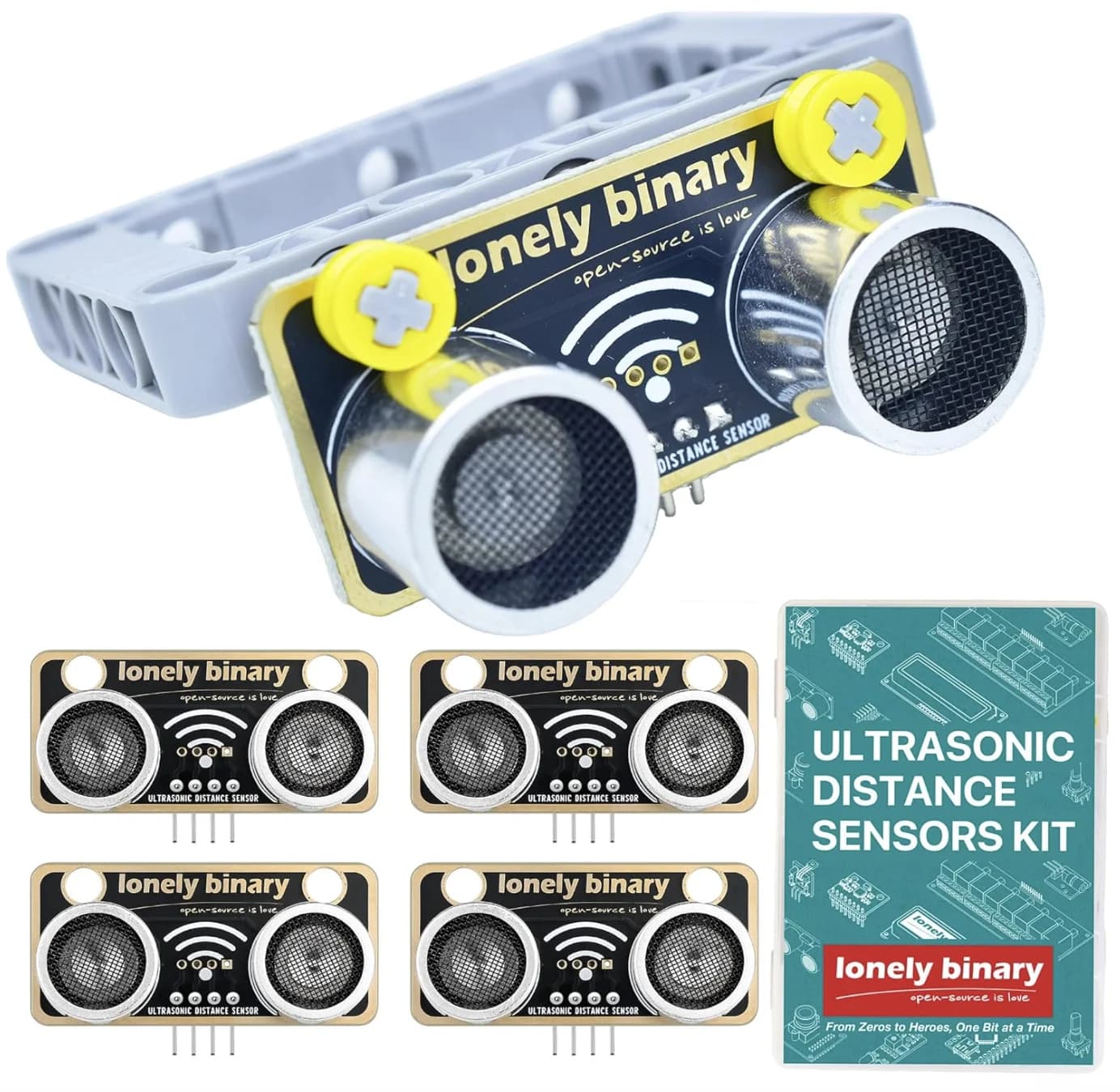
Distance by echo timing, five to a pack — enough for a robot with a sensor on every side.
Your 3 steps
Saved in this browserFour wires, no library, and why the first number you print looks like nonsense.
Two pads decide whether the sensor speaks GPIO, I2C, UART or 1-Wire. Both arrive open.
The 4 m on the box, the 2–3 m to design to, and the surfaces that return nothing at all.
What is in your box
Each part links to its own page, written once and shared across kits.
Product questions
See what other owners have asked, and read their solutions.
TinkerBlock Ultrasonic Distance Sensor Kit
Loading discussions…
Quote TBULTRA and the error text. Weekdays, Sydney time, usually the same day.
Contact us about your order →Every module page carries a board switcher. Pick yours once and the pins and the code follow you across the site.
Compare the boards →What this is for
The sensor that finally makes a microsecond feel like a real unit. You send a pulse, you time the echo, and the arithmetic in between is the whole lesson.
Five, not one
One sensor is a demo. Four is a robot that knows what is around it — front, back and both sides — and the fifth is the one you break. That is the reason this ships as a pack rather than a single part.
It is also why the four protocols do not have to be decided today. Choosing one means soldering a bridge, which is not something you undo casually, so most people leave the boards as they came and commit one or two when a build actually needs a bus.
The thing that catches people
Not the supply. The listing calls this an HC-SR04, and an HC-SR04 is a 5 V part
whose echo pin needs a divider before it can touch a 3.3 V board. These are
not that part. The chip is an RCWL-9610A, the board prints 3.3V-5V on the
back, and there is no regulator between the header and the chip — so power it
from 3V3 and the echo comes back at 3.3 V, straight into an ESP32 pin with
nothing in the way.
Not the HC-SR04 you know
is the long version.
What does catch people is zero. There is no error this sensor can report, so a soft surface, an angled surface, an empty room and a genuine fault all arrive as the same thing: no echo, which a sketch will cheerfully convert to 0.0 cm. Treat a timeout as "unknown" rather than as a distance.
Distance also drifts with temperature, because the speed of sound does. It is about 343 m/s at 20 °C and roughly 0.6 m/s faster per degree — which is under a centimetre over a couple of metres, and worth knowing before you blame your code.
Edit this page — content/kits/tinkerblock-ultrasonic.mdx