
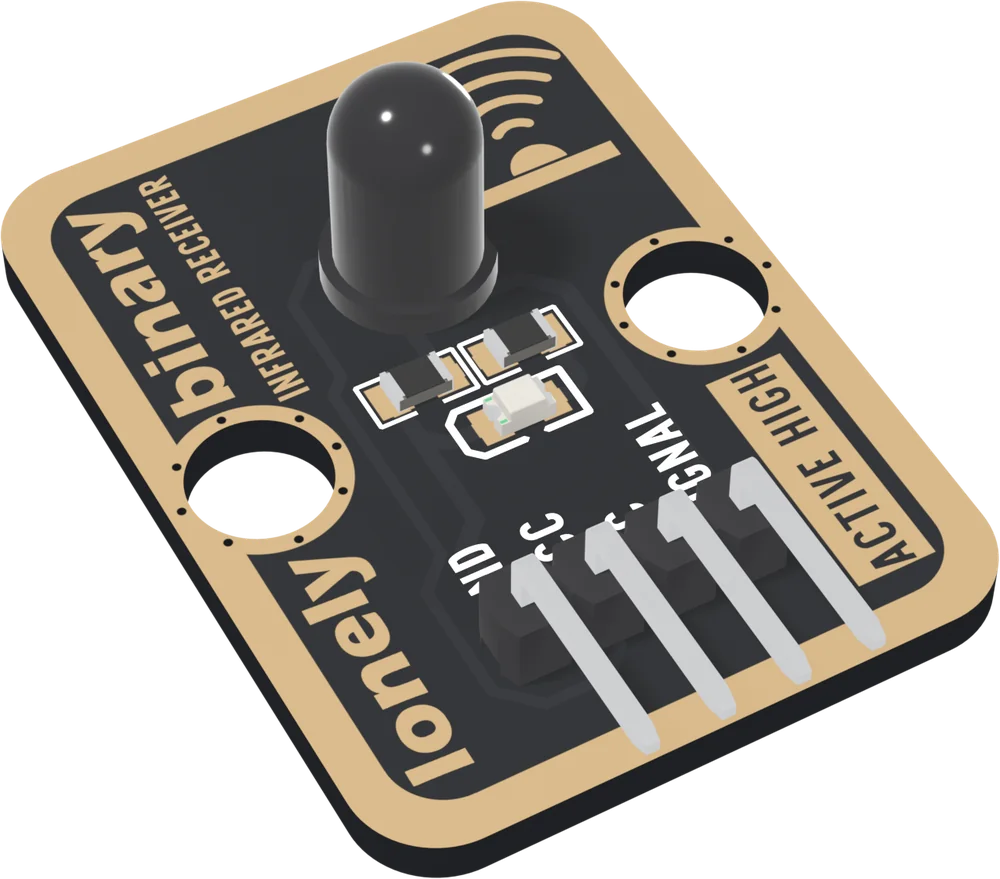
The TK64 at an angle: a black board with a gold border, a black 5 mm dome standing straight up near the top beside a white infrared-waves drawing, two small resistors and an LED under it, two round LEGO holes, lonely binary and INFRARED RECEIVER up the left edge, ACTIVE HIGH in a box on the right, and a right-angle four-pin header.
VR

View it in VR

This board opens in a VR headset: life-size, or big enough to stand beside, with every pin and every part named where it sits. Open this address in the browser on a headset such as Apple Vision Pro or Meta Quest.

learn.lonelybinary.com/vr/tk64
You have this

Infrared Receiver

An infrared light sensor on a TinkerBlock board: an Everlight PT334-6B phototransistor in a black 5 mm package and a 10 kΩ load, so SIGNAL is an analog voltage that rises with how much infrared arrives, steady or flashing. The partner of the TK63 for a break-beam. It is not the TK15 IR Receiver: it decodes no remote, and the TK15 ignores steady light.

Peak
940nm; the TK63's colour
SIGNAL
1V per 0.1 mA; about 0 V dark
Tops out near
2.9V from 3V3; VCC is your logic voltage
Decodes remotes
Nothat is the TK15

Turn it over and see the three holes to wire: GND, VCC and SIGNAL. VCC reaches only the phototransistor's collector; its emitter is SIGNAL, with a 10 kΩ load to GND that turns the infrared into a voltage.

Product questions & answers ↓

Community

Product questions

See what other owners have asked, and read their solutions.

Ask a question ↗

Infrared Receiver

Loading discussions…

Need another

Not on general sale yet. Reply to your order and we will sort out a spare — quote tk64.

Order or missing parts?

Email us or reply to your order, and quote tk64 — that identifies the product. If something is missing from the bag, your order is the record of what shipped.

Take it with you

Point a phone camera at the code and this page opens there. It is the same address as the one printed on your box, so it is also what to show someone you are passing the board to.