
Small messages over a longer link
A LoRa radio is built to send a few bytes now and then, a long way, on a battery. This lesson sets the job on one Australian farm and shows what a six byte soil report costs in time on the air, and why that is the price that matters.
The job
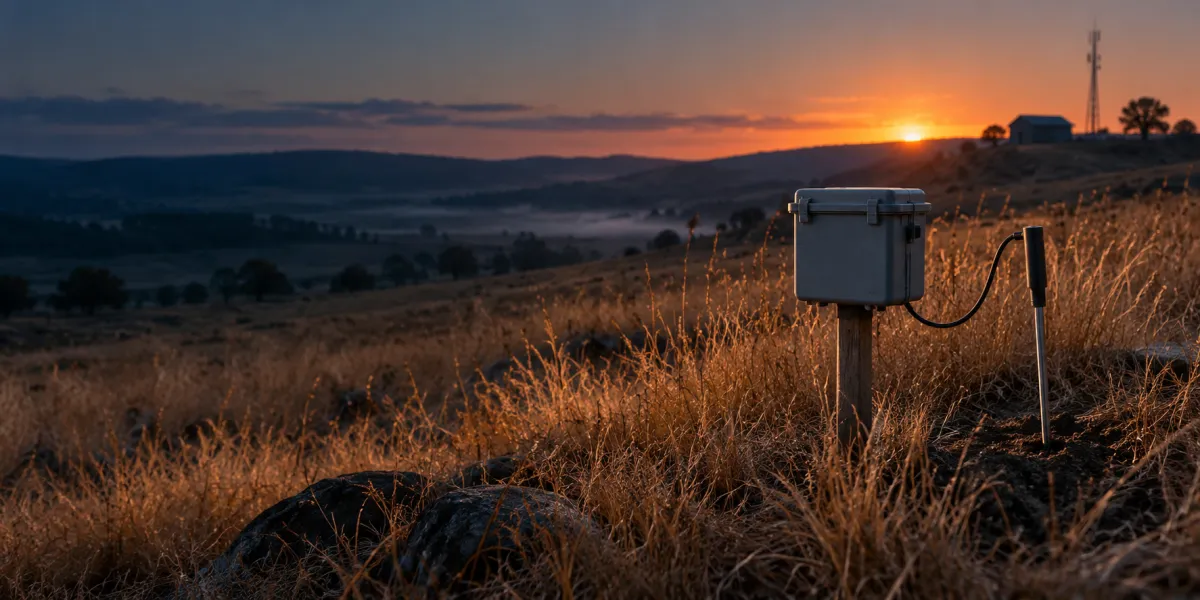
A soil probe in a paddock has one thing to say, how wet the ground is, and it has to say it a few times an hour for years, from a long way from any router, on a battery. A tank gauge is the same. Wi-Fi was built for the opposite job: a lot of data, close to an access point, from a device with a mains socket nearby. LoRa trades speed for reach and for a radio that is on the air for a fraction of a second a day.
What a report costs
The report on the bench is six bytes: which probe, how wet, and the battery. At the course's reference settings it occupies the channel for about 124 milliseconds. That time is the cost. It is energy from the battery, and it is a window in which another packet can overlap. Ask for a bigger message and the time goes up in steps. Report less often and the radio is on the air for a smaller share of the day.
A photograph of the paddock makes the trade plain. A Wi-Fi link moves it in a hundredth of a second. At this setting's nominal rate, under two kilobits a second, the same hundred kilobytes would need minutes of continuous transmission. LoRa is not a slow Wi-Fi. It is built for the other kind of message.
The map is a schematic
The farm on the bench is a schematic, not to scale, with a gateway on the shed roof. It shows where things are installed, and nothing else. Whether a probe's report reaches the gateway depends on antenna heights, the path, the hill, and what the receiver can hear at the chosen settings. There is no distance at which a LoRa link is guaranteed, and no circle on a map that means covered. The lessons ahead build the estimate piece by piece, and show the assumptions each time.
Where this goes
The next lessons take the radio apart: the chirp that carries a symbol, the settings that trade time against sensitivity, and the airtime that every byte costs. The last lesson puts a module beside an ESP32, and hands over to the LoRa chapter of the ESP32 book.
Common mistakes
- Treating LoRa as a long-range Wi-Fi. It carries small, occasional messages at a low rate. Bulk data is the wrong job for it.
- Reading a distance off the map. The map shows installation, not reception. A link is an estimate from the whole budget, with a margin.
- Counting bytes instead of time. A message costs the time it occupies the channel, and that moves in steps and with the settings.
Edit this page — content/fundamentals/lora/small-messages-over-a-longer-link.mdx
Discuss this article
Ask about this page. The answer stays here, on the page it belongs to, for whoever hits the same wall next.