
One shared channel
The first Ethernet was one coaxial cable that every station heard. Each listened before sending, stopped when two collided, and waited a random number of time slots, from a range that doubled after every repeat.
Where the idea came from
The idea began with radio. In June 1971 the Aloha network at the University of Hawaii let terminals share one radio channel, sending at random. At Xerox's Palo Alto Research Center, a memo by Bob Metcalfe dated 22 May 1973 sketched a network on coaxial cable instead, and named it after the ether. In July 1976 Metcalfe and David Boggs described it in Communications of the ACM.
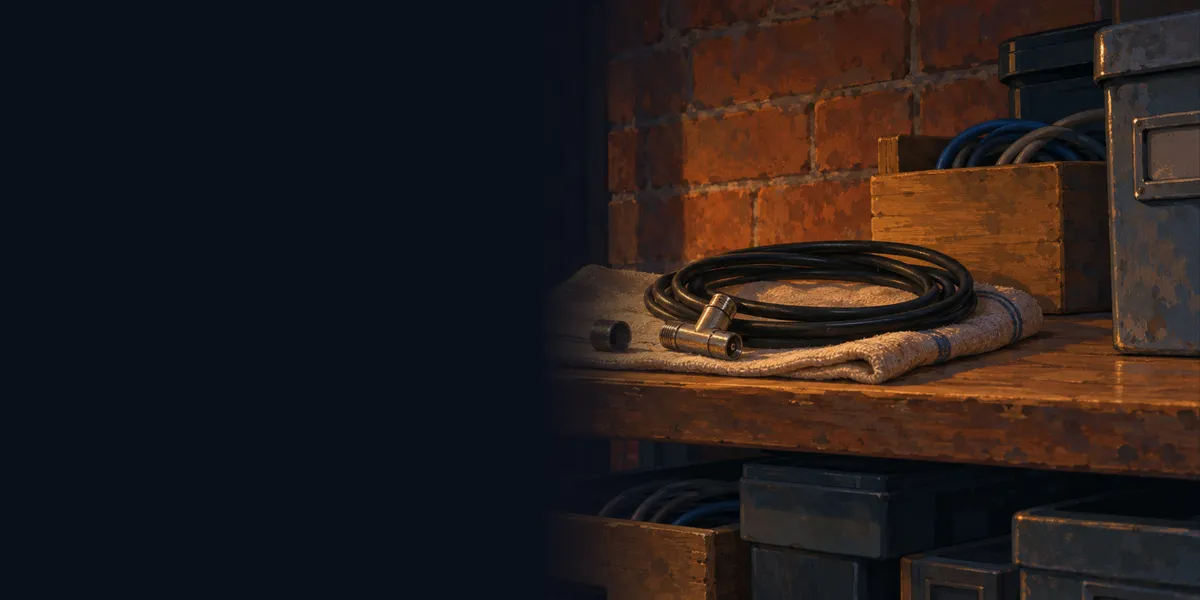
Every station was joined to the one cable, so every station heard every other. On thin coax, a T-piece joins each station and a terminator closes each end of the cable.
Listen first
A station that has something to send listens to the cable first. If another station is sending, it waits, and sends only once the cable is quiet. That is carrier sense: a station never starts on top of a transmission it can already hear.
Listening cannot stop every collision. Two stations that both find the cable quiet at the same moment both start.
When two start together
Both detect the collision while they are still sending, send a short jam signal, and stop. Both attempts are lost. This is where Ethernet differs from CAN: there, the losing sender drops out and the winner's frame carries on unharmed. A CSMA/CD collision spoils both.
The rules need a sender to still be sending when news of a collision from the far end gets back to it. That is why there is a slot time, 512 bit times, and why the shortest frame is 64 bytes, one slot long.
A wait that grows
After a collision each station waits a random whole number of slots. After the first, the choice is 0 or 1, so the two can easily draw the same number and collide again. After every repeat the range doubles, up to a limit: 0 to 3, then 0 to 7, so two stations soon draw different numbers, and the one with the shorter wait goes first. A frame that keeps colliding is given up after a limited number of tries.
Listen before sending, detect a collision while sending, back off: carrier sense multiple access with collision detection, CSMA/CD. Digital, Intel and Xerox published a joint Ethernet specification in 1980, and the IEEE approved its own standard, 802.3, on 23 June 1983. The board side, a link to a switch from an ESP32, is Ethernet instead of Wi-Fi.
Common mistakes
- Thinking a collision delivers two damaged frames. Both senders detect it, jam and stop. Neither attempt gets through, and each tries again after its wait.
- Thinking the stations take turns in a fixed order. The wait is drawn at random, from a range that doubles after every repeat. Two stations can draw the same number and collide again.
- Thinking a modern link still does this. CSMA/CD is for half-duplex sharing. A full-duplex link to a switch does not use collision detection; a hub or a shared segment still does.
Edit this page — content/fundamentals/ethernet/one-shared-channel.mdx
Discuss this article
Ask about this page. The answer stays here, on the page it belongs to, for whoever hits the same wall next.