audio
4 pages across tutorials, modules, pinouts and guides.
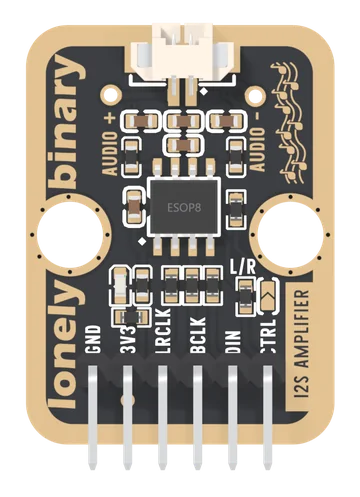
I2S Amplifier
An NS4168 I2S amplifier on a TinkerBlock board: the ESP32-S3 sends sound as numbers on three wires and the chip drives a 4 Ω speaker, about 1 W on 3.3 V. CTRL must be driven HIGH or it stays off, the L/R jumper picks which channel the mono chip plays, and neither speaker wire is ground.
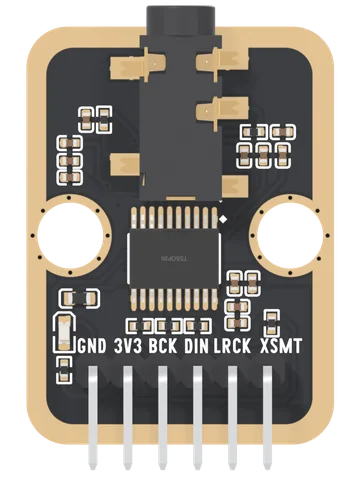
I2S DAC
TI's PCM5102A stereo DAC and a 3.5 mm jack on a TinkerBlock board, for the ESP32-S3, which has no DAC of its own. Three wires carry the samples in and the chip makes its own master clock from the bit clock. The output is line level, 2.1 V RMS: headphones and powered speakers, never a bare speaker. 3.3 V only, and XSMT is already held HIGH.
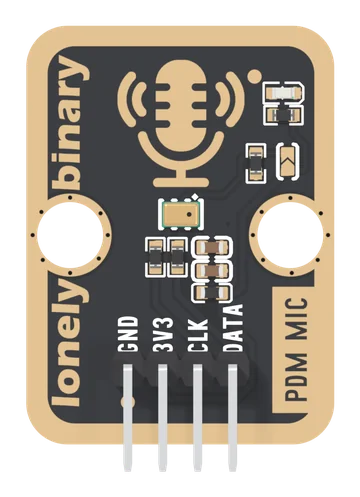
PDM Microphone
A LinkMems LMD2718T261-OA1 MEMS microphone on a TinkerBlock board that sends sound as one bit per clock pulse. It needs a board with a PDM input, such as the ESP32-S3's I2S0, and 3.3 V. Two signal wires, CLK in and DATA out; ordinary speech reads a few tens out of 32767, so sketches subtract an offset and apply gain.
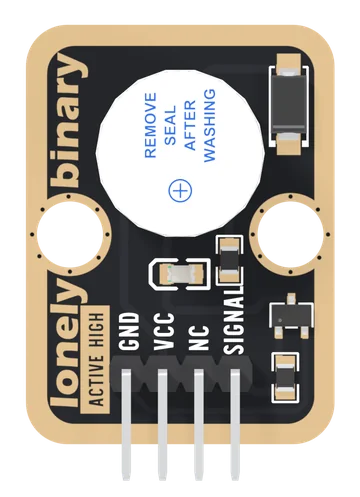
Active Buzzer
A 12 mm electromagnetic buzzer with its own oscillator, on a TinkerBlock board. SIGNAL HIGH beeps at about 2.4 kHz, LOW stops it: one note, one line of code. An S8050 transistor switches it from VCC, so your pin gives a few milliamps and VCC can be 5V beside a 3.3 V board. There is no pull-down on SIGNAL, so use a pin that stays LOW while your board boots.