Specifications
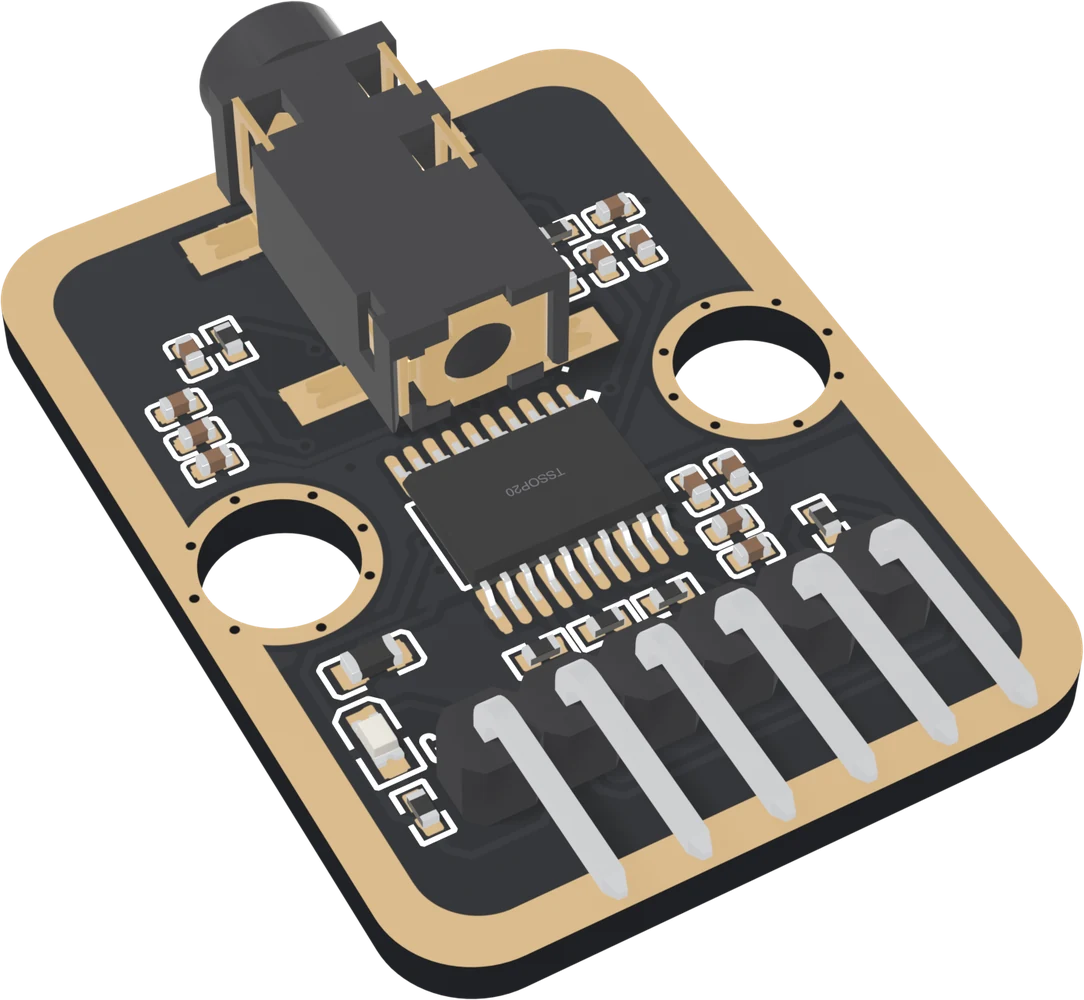
| Type | Stereo DAC with a 3.5 mm line output. It turns I2S samples from the ESP32-S3 into a voltage for headphones or a powered speaker; it is not an amplifier |
|---|---|
| Chip | TI PCM5102A (PCM5102APWR), TSSOP-20. 16, 24 or 32-bit samples at 8 to 384 kHz, I2S format |
| Output | 2.1 V RMS full scale, line level, ground-centred by a built-in charge pump, so no DC-blocking capacitors. 470 Ω and 2.2 nF on each channel, TI's recommended filter, corner about 154 kHz |
| Supply | 3.0 to 3.6 V on 3V3, about 20 mA typical: a 3.3 V board. The absolute maximum is 3.9 V, so never 5 V |
| Performance | 112 dB dynamic range and SNR, THD+N −93 dB, typical, from TI's datasheet (48 kHz, 24-bit, 10 kΩ load). Not measured on this board |
| Header | 6-pin right-angle male, 2.54 mm: GND, 3V3, BCK, DIN, LRCK, XSMT. GPIO 42, 41, 40 and 39 in the book |
| XSMT | Soft mute, held HIGH by a 10 kΩ pull-up, so the DAC plays with nothing connected. Driven LOW it ramps the sound down; HIGH ramps it back up |
| Clocks | Three-wire I2S: the chip's PLL makes its master clock from BCK. It locks at 32 or 64 bit clocks per sample from 32 kHz up, 64 only at 16 kHz, and not at all at 8 kHz |
| Jack | 3.5 mm stereo (PJ-327A): left, right and ground. For headphones, earbuds and line inputs, never a bare speaker |
| Host | A board with I2S, such as the ESP32-S3. An Arduino Uno or Nano has no I2S peripheral |
| Board | 22.4 × 30.4 mm TinkerBlock board, two LEGO-compatible holes, red power LED |
| In the box | The I2S audio kit: TK103 DAC, TK100 amplifier, TK101 PDM microphone, a 4 Ω 3 W speaker for the TK100, a 3.5 mm to 3.5 mm cable and a 3.5 mm to RCA cable. Headers fitted |
What it does
The ESP32-S3 can make sound as numbers but has no DAC to turn them into a voltage. The TK103 is that DAC: the ESP32-S3 sends samples on three wires, and TI's PCM5102A puts left and right on a 3.5 mm jack at line level, the signal headphones and a powered speaker's input expect.
Two things to know before wiring
- Line level, not speaker level. Headphones and powered speakers go in the jack. Never a bare speaker, and never a speaker amplifier's output.
- 3.3 V only. Take the supply from the ESP32-S3's 3V3 pin, never 5 V.
Wiring, in four lines
- GND to GND, 3V3 to 3V3.
- BCK to GPIO 42, DIN to GPIO 41, LRCK to GPIO 40.
- XSMT to GPIO 39 if the sketch should mute; otherwise leave it off.
- Headphones or a powered speaker in the jack.
Where to start
The handbook below is nine short articles. Read What is on the board before wiring, Three wires, no master clock before choosing a sample rate, and Headphones, powered speakers, never a bare speaker before plugging anything in. Left, then right is the first sketch; Internet radio plays an MP3 station in stereo.
The rest of the kit
The TK103 comes in the I2S audio kit with the TK100 I2S amplifier, which drives the kit's speaker, and the TK101 PDM microphone. The book's pin map keeps all three on separate GPIOs, so any two can be wired to one ESP32-S3 at once.
When it doesn’t work
- Can I plug a speaker straight into the jack?
- Not a bare one. 2.1 V behind the board's 470 Ω cannot move a speaker cone: a 4 Ω speaker gets about 18 mV, worked out. Use a powered speaker, or put the kit's speaker on the TK100 amplifier.
- Do headphones work?
- Yes, at a moderate volume. 32 Ω headphones get about 0.13 V RMS at full scale through the board's 470 Ω, worked out: plenty for earbuds, modest for big headphones. For loud, use powered speakers.
- Do I have to connect XSMT?
- No. A 10 kΩ resistor on the board holds it HIGH, which means play. Wire it to a GPIO only if the sketch should mute.
- Can I power it from 5 V?
- No. The PCM5102A runs from 3.0 to 3.6 V with an absolute maximum of 3.9 V. Take the supply from the ESP32-S3's 3V3 pin.
- Why is it silent at 8 kHz or 16 kHz?
- With no master clock the chip builds one from the bit clock, and only for the rates in TI's table. 8 kHz is not listed; 16 kHz needs 32-bit slots. At 44.1 and 48 kHz, 16-bit stereo works.
- Does it work with an Arduino Uno?
- No. The Uno's ATmega328P has no I2S peripheral, and its pins are 5 V. Use an ESP32-S3.