What is in the box
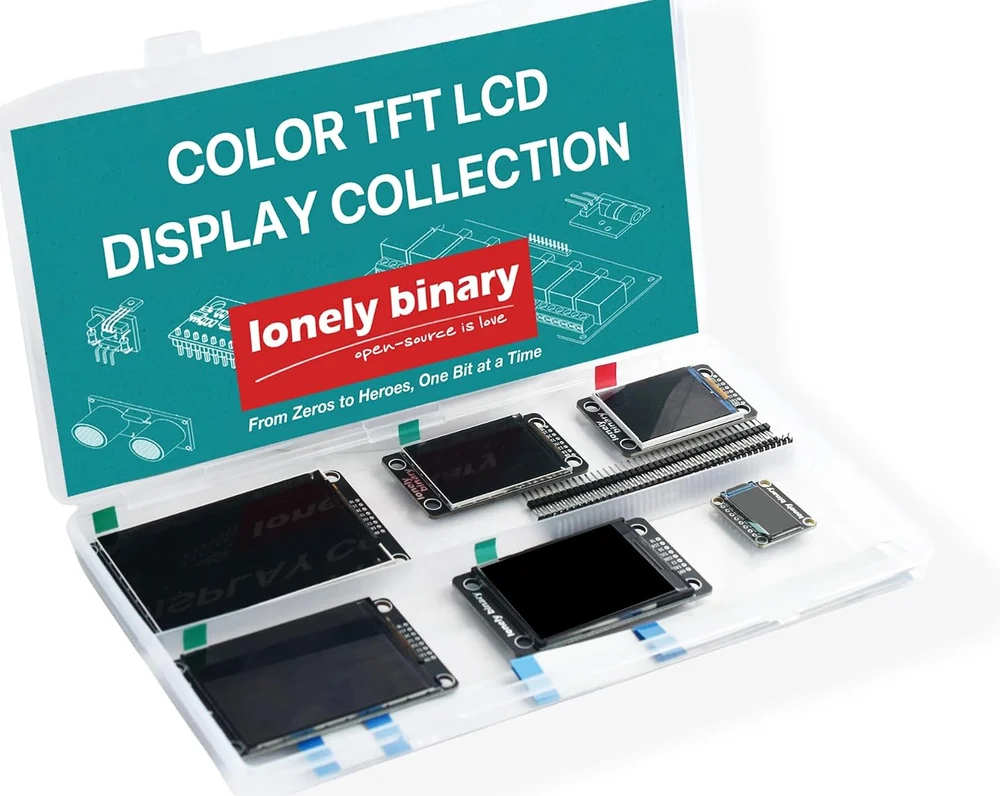
Six panels, nine ribbon cables in three lengths, and four strips of breakaway header. The spare cables are deliberate, and the header is only for people not using the ribbon.
What the tray holds
Six displays, nine cables and four strips of header, in a hinged plastic case with the panels taped down. Nothing else, and nothing else is needed — no adapter boards, no separate breakout per size.
The spares are not generosity
Nine cables for six panels means three spares, and the reason is that the ribbon is the part of this kit most likely to fail. It is a flat plastic tail with fifteen conductors printed on it. Fold one sharply and a conductor can crack while the plastic stays smooth, which gives you an intermittent fault that comes and goes as you move the cable — the worst kind to diagnose, because everything else in the circuit is fine.
If a working display starts misbehaving when you touch the cable, change the cable before you change anything else.
The headers are the other route
Two straight strips and two right-angle. These are for the row of eight pads on the back of each board, and you only need them if you are not using a ribbon — wiring into a breadboard, or onto a board that has no FPC socket.
They are breakaway strips, much longer than eight pins. Snap off the eight you need and put the rest back in the case.
Straight header points out of the back of the board, which suits a panel lying flat on a bench. Right-angle points along it, which is what you want when the display is going to sit upright in an enclosure with wires leaving sideways.
What is not in the box
A microcontroller, and — if yours runs at 5 V — a level converter. Every panel here is a 3.3 volt part and the boards say so in print on their own back panels. That is the next thing worth getting right, and it has an article of its own.
When it does not work
Three spares, and you will want them. A flat ribbon is the most fragile thing in the case: crease one and a conductor inside it can break while the plastic still looks perfect, which produces a fault that moves when you wiggle the cable. Replacing it is the fix, so the kit ships you replacements.
No. Every panel arrives with its FPC connector already fitted, and a ribbon into that connector is a complete connection. The headers are the alternative for people wiring to a breadboard, and they are optional.
They are meant to be. Breakaway header snaps by hand or with pliers at any pin — count off eight, break there, and keep the rest for the next board. Trying to use a whole strip on an eight-pad row is the mistake; nothing on these boards takes forty pins.
The shortest one that reaches. A ribbon is an unshielded flat cable carrying a clock at tens of megahertz, and the longer it is the more likely the picture is to arrive scrambled. If a long cable misbehaves, the fix is to slow the SPI clock down or use a shorter cable.
BL, RST, DC, SCL, MOSI, CS, 3V3, GND — and why nobody guesses that order.
Eight pads, in order →Edit this page — content/books/spi-tft-kit/whats-in-the-box.mdx
Questions about this product
See what other owners have asked, and read their solutions.
SPI TFT LCD Display Kit, 6-Pack from 0.96 to 3.5 inch
Loading discussions…
Discuss this article
Ask about this page. The answer stays here, on the page it belongs to, for whoever hits the same wall next.