
infrared
5 pages across tutorials, modules, pinouts and guides.
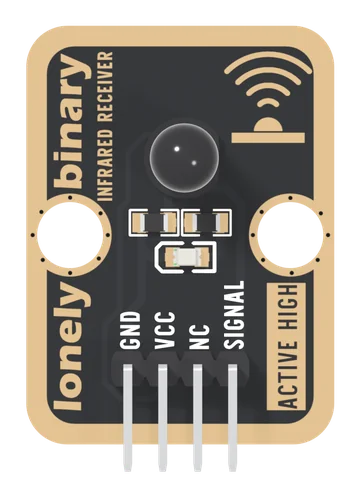
Infrared Receiver
An infrared light sensor on a TinkerBlock board: an Everlight PT334-6B phototransistor in a black 5 mm package and a 10 kΩ load, so SIGNAL is an analog voltage that rises with how much infrared arrives, steady or flashing. The partner of the TK63 for a break-beam. It is not the TK15 IR Receiver: it decodes no remote, and the TK15 ignores steady light.
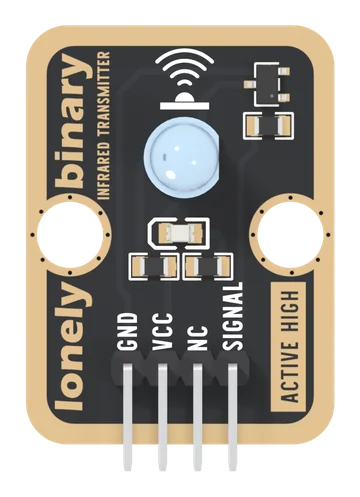
Infrared Transmitter
A 5 mm, 940 nm infrared LED on a TinkerBlock board, switched by an S8050 transistor, with one 150 Ω resistor setting its current from VCC and a red LED that shows when it is on. SIGNAL HIGH turns it on. Your pin only feeds the transistor, so VCC may be 5 V on a 3.3 V board. Blink it, send remote-control codes to a TK15, or make a break-beam with a TK64.
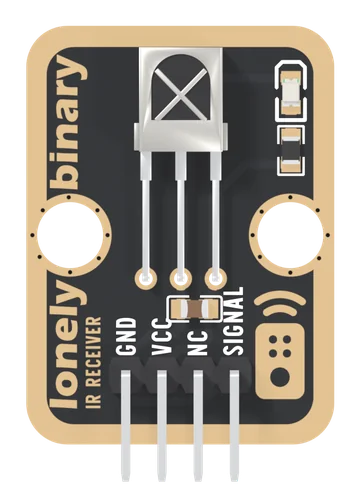
IR Receiver
A Vishay TSOP18138 38 kHz infrared receiver on a TinkerBlock board: SIGNAL idles HIGH and goes LOW while a remote sends, and the IRremote library turns those lows into an address and a command.
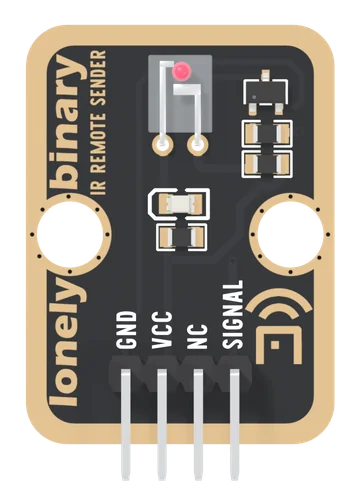
IR Sender
An Everlight IR908-7C 940 nm infrared LED, switched by a transistor, on a TinkerBlock board. SIGNAL HIGH lights it; your microcontroller makes the 38 kHz carrier, and one 150 Ω resistor decides how far it reaches.
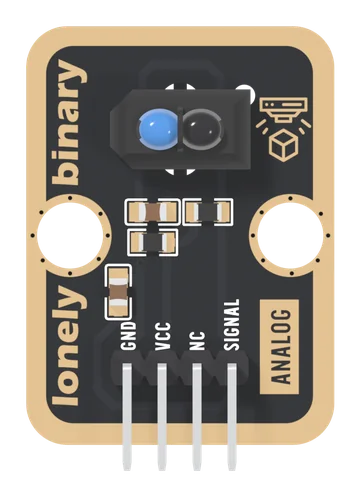
Reflective Optical Sensor
A Vishay TCRT5000 on a TinkerBlock board: an infrared emitter that is always on and a phototransistor beside it, both looking out of the front. Infrared coming back pulls SIGNAL down from VCC through 4.7 kΩ, so white paper reads low and black tape or open air reads high. Analog only, best at 2.5 mm, and VCC goes to your board's logic voltage: 3V3, or 5V on an Uno.