Three boards, three shields
The boards do the charging and the computing; the shields are what you wire to. All three shields are the same board with a different edge — pin header, spring terminal or screw terminal — and the same switch, fuse and battery sockets in the middle.
What is in the box
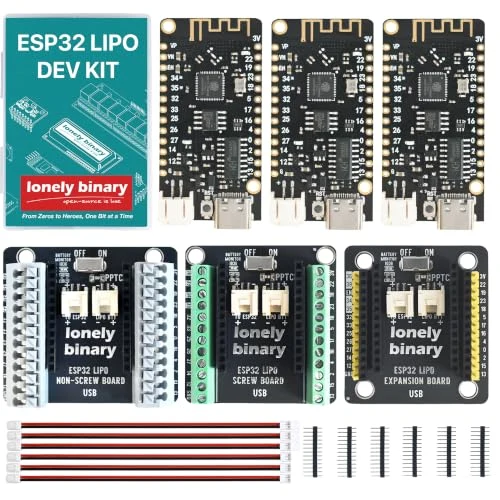
- 3 ESP32 LiPo boards. The header strips are not fitted.
- 6 male header strips, two for each board.
- 3 shields, one of each kind, assembled.
- 6 JST PH 2.0 cables with a plug at each end.
- A storage case. There is no cell in the box.
The board
A classic ESP32 — two cores, 2.4 GHz Wi-Fi, Bluetooth Classic and BLE — with 4 MB of flash. A USB-C socket and a CH340 chip handle power and uploads. There is a RST button, an LED on GPIO 22, and a white battery socket at the bottom corner with a charger behind it.
It is a complete board on its own: plug a cell straight into its socket and it charges and runs from it. What it does not have is a switch.
The shields
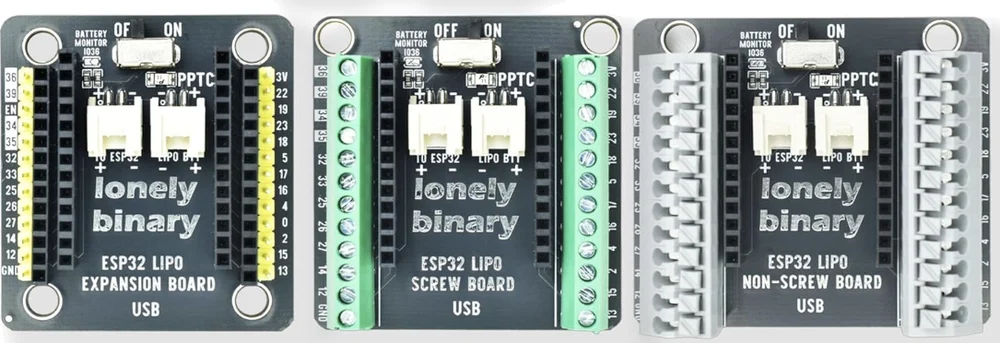
The middle of every shield is the same: a slide switch, a resettable fuse marked PPTC, a solder pad marked BATTERY MONITOR IO36, and two battery sockets. LIPO BTT is where the cell goes. TO ESP32 is where one of the six cables starts; its other end goes into the board's own battery socket. That cable is how the cell reaches the board — none of the 26 pins carries it.
What differs is the edge:
The cables
Six short red-and-black leads with a JST PH plug at both ends. It takes one to join a shield's TO ESP32 socket to a board, so there is a spare for each. Check that the red wire runs from the + mark at one end to the + mark at the other.
When it does not work
The 2.54 mm header shield, if your parts come with jumper wires. Every pin has a male and a female header beside it, so a jumper goes straight on. Move to the spring or screw shield when the wiring stops changing.
The header strips onto the boards, yes — they ship loose, two per board. The shields are finished and need no soldering, apart from the battery monitor pad if you decide to use it.
They carry the board's 26 pins out to something you can wire to, and add the parts the board lacks for a battery project: an ON/OFF switch, a resettable fuse, a second battery socket and a way to measure the cell.
Thirteen free, four that only listen, five that decide how the board starts.
The 26 pins, and the ones to be careful with →Edit this page — content/books/esplipo/three-boards-three-shields.mdx
Questions about this product
See what other owners have asked, and read their solutions.
ESP32 LiPo Dev Kit: 3 Boards with LiPo Charger + 3 Shields
Loading discussions…
Discuss this article
Ask about this page. The answer stays here, on the page it belongs to, for whoever hits the same wall next.