The 120 Ω resistor
A long cable sends an edge back from its far end like an echo, and the echo arrives as noise on the bits that follow. A resistor across A and B equal to the cable's own impedance, about 120 Ω, absorbs the edge instead. Every board ships with one fitted, and on a real bus only two should keep it.
An edge travels
When the driver switches A and B, the change does not appear along the whole cable at once. It travels, at about two thirds of the speed of light: roughly 5 ns for every metre. At the far end it has to go somewhere.
If the far end is open, the edge reflects and comes back, then reflects again off the driver, a little smaller each time, until it dies away. At the receiver this looks like a step that overshoots and rings.
A resistor that matches the cable
A cable has an impedance of its own, set by the wires and how closely they are twisted; for twisted pair it is about 100 to 120 Ω. An edge arriving at a resistor of that value is taken completely, as if the cable carried on for ever. Nothing comes back. That is termination, and the resistor is the terminator.
RS485 is terminated at both ends of the cable, because either end's board may be the one talking, and an edge heads both ways from a board in the middle.
When it matters
The echoes last a few round trips of the cable. Whether that hurts depends on how long a bit is:
| Cable | Round trip | Ringing, about | One bit at 9600 | One bit at 115200 |
|---|---|---|---|---|
| 1 m | 0.01 µs | 0.03 µs | 104 µs | 8.7 µs |
| 100 m | 1 µs | 3 µs | 104 µs | 8.7 µs |
| 1000 m | 10 µs | 30 µs | 104 µs | 8.7 µs |
On a desk, it does not. On a long cable at a high baud rate, the ringing from one bit is still going when the next is read. A slower baud rate is the other cure, and many long industrial buses run at 9600 for that reason.
Where it is on the board
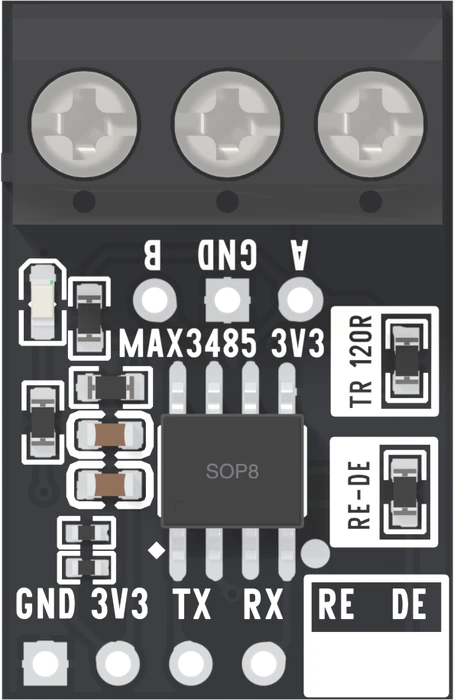
The terminator is the small resistor in the box printed TR 120R, wired straight across A and B. It is on every board in the box, which is right for the two boards at the ends of a cable and wrong for every board in between.
When it does not work
They will. On a metre of wire the echoes are over in nanoseconds, far inside one bit. The resistor starts to matter at tens to hundreds of metres, or at high baud rates. On a bench, leaving both fitted is fine.
Yes. The aim is to match the cable, and twisted-pair cables run about 100 to 120 Ω. Anything in that neighbourhood absorbs nearly all of the edge; what matters far more is that there is one at each end and none in between.
The one inside the white box printed TR 120R, on the right-hand side near the terminal. It is marked 121, which is how a 120 Ω chip resistor is printed: 12 followed by one zero.
Why a bus built straight from the box has too many, and how to take them off.
Only the two ends keep it →Edit this page — content/books/rs485/the-120-ohm-resistor.mdx
Questions about this product
See what other owners have asked, and read their solutions.
This page covers several products. Choose yours to see the right discussions.
Discuss this article
Ask about this page. The answer stays here, on the page it belongs to, for whoever hits the same wall next.