What is in the box
Twelve boards: six with a MAX485 for 5 V microcontrollers and six with a MAX3485 for 3.3 V ones. The same circuit on the same layout, and the only question is which one goes with your board. Both kinds talk to each other on the same pair.
Two boards, one circuit
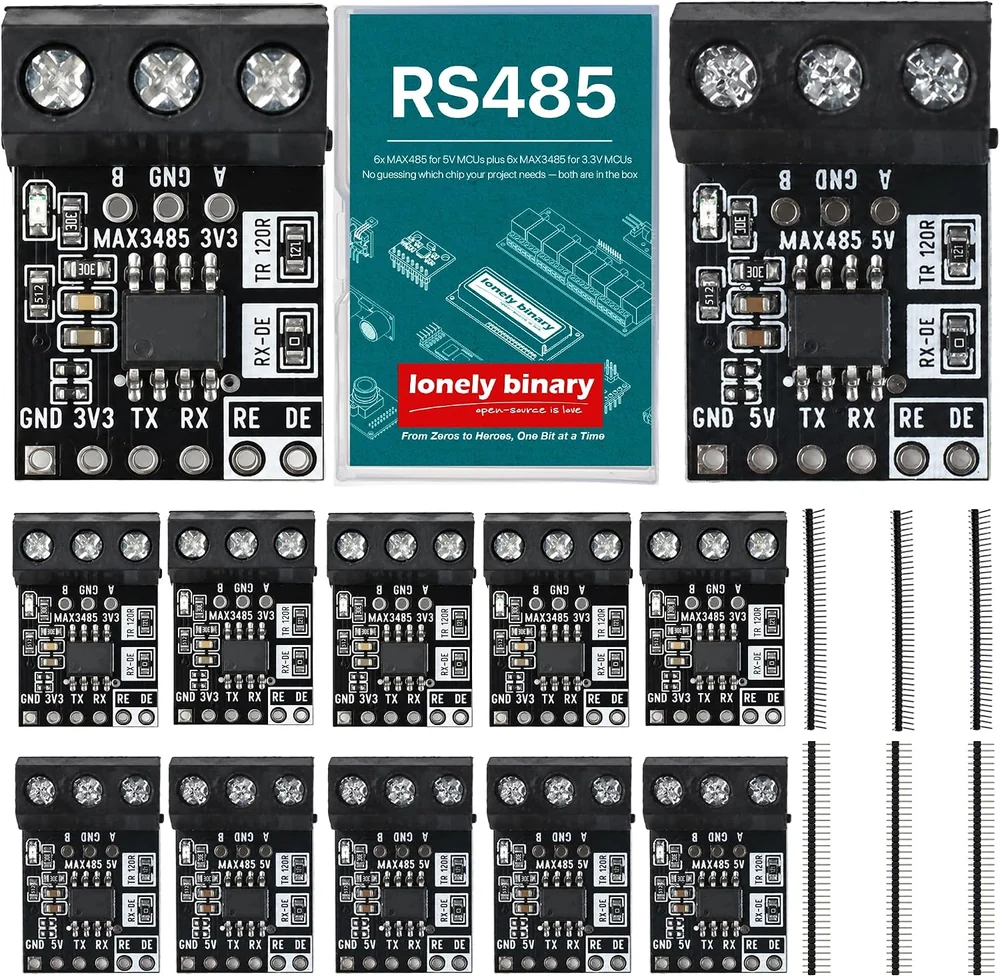
The two boards are the same circuit on the same layout, part for part. The only differences are the chip and the voltage it runs at:
| MAX485 board | MAX3485 board | |
|---|---|---|
| Printed | MAX485 5V | MAX3485 3V3 |
| Runs at | 4.75 to 5.25 V | 3.0 to 3.6 V |
| For | Arduino Uno, Nano, Mega | ESP32, Raspberry Pi Pico, STM32 |
| Fastest | 2.5 Mbit/s | 10 Mbit/s |
Both have a screw terminal for A, GND and B, the same six holes along the bottom edge, a 120 Ω resistor between A and B, and a 0 Ω link joining RE to DE. Those last two are what most of this book is about.
Which one is yours
The wire that decides is the board's TX, which carries what it heard on the bus into your microcontroller. It swings to the board's own supply. A 5 V board puts 5 V on that pin, which a 3.3 V microcontroller is not built to take. A 3.3 V board puts at least 2.9 V there, which a 5 V Uno is not guaranteed to read as a 1: nothing breaks, and now and then a byte goes missing.
So the rule is one line: the board runs at the same voltage as your microcontroller, and is powered from its 5V or 3V3 pin.
They share a bus
The logic voltage stays on the board. What goes down the cable is only the difference between A and B, and both chips make and read that the same way. A MAX485 board on an Uno and a MAX3485 board on an ESP32 talk to each other over one pair.
Headers
The strips are loose. Solder the six holes along the bottom edge, with straight pins to stand the board in a breadboard or right-angle pins to lay it flat. The bus side needs nothing soldered: A, GND and B go into the screw terminal.
When it does not work
By the printing beside the chip and on the back: MAX485 5V on one, MAX3485 3V3 on the other. The supply pin along the bottom edge is printed 5V or 3V3 to match. The chips themselves are too small to read without a magnifier.
Yes. The bus does not carry either logic voltage: both chips drive A and B the same way and read them the same way. An Uno with a MAX485 board and an ESP32 with a MAX3485 board can talk over one pair. Pick each board for the microcontroller it is wired to.
Probably not at once: the MAX3485's absolute limit is 7 V. But it is built for 3.0 to 3.6 V, and at 5 V its outputs put 5 V on a 3.3 V microcontroller's pin, which is where the damage happens. Move it to 3.3 V and check the microcontroller's RX pin still works.
They ship loose, straight and right-angle, so you can choose: straight to stand a board in a breadboard, right-angle to lie it flat in a case. Solder only the six holes along the bottom edge; the bus side has the screw terminal.
Every hole on the board, and the one whose name misleads everybody.
Six pins and a terminal →Edit this page — content/books/rs485/whats-in-the-box.mdx
Questions about this product
See what other owners have asked, and read their solutions.
This page covers several products. Choose yours to see the right discussions.
Discuss this article
Ask about this page. The answer stays here, on the page it belongs to, for whoever hits the same wall next.