Audio
Microphones, speakers, I2S and amplifiers. Sound in, sound out, and the DAC in between.
17. Passive Buzzer
Learn tone() and noTone(); outcome: buzzer plays Do, Re, Mi in sequence then stops; can be extended to simple melodies.
18. Active Buzzer
Learn to control the active buzzer with digitalWrite() and const; outcome: buzzer on 0.5 s, off 0.5 s, repeat.
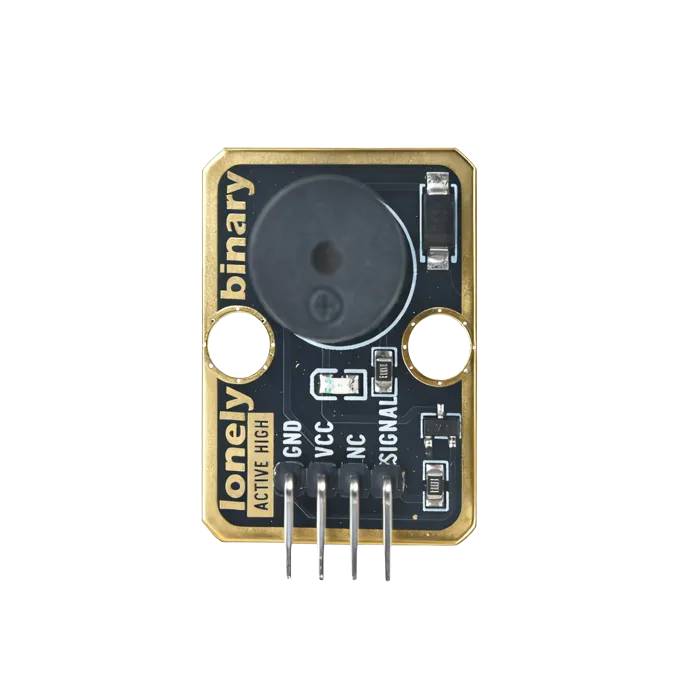
Active Buzzer
One pin, one tone. It makes a noise when you set the pin high, and that is genuinely the whole story.
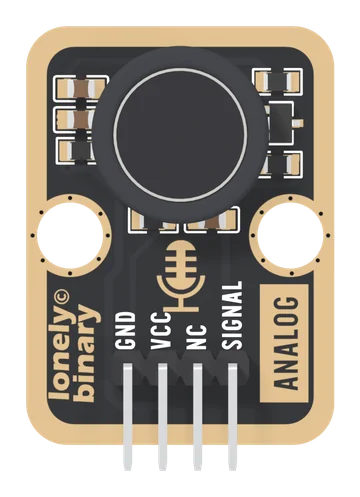
Analog Microphone
An electret capsule and a one-transistor amplifier on a TinkerBlock board. SIGNAL rests at a level set by the transistor's gain and swings above and below it with sound, in a band of roughly 75 Hz to 1 kHz. Read the peak-to-peak over 50 ms: it hears claps, knocks and loud voices, and it is not a recording microphone.
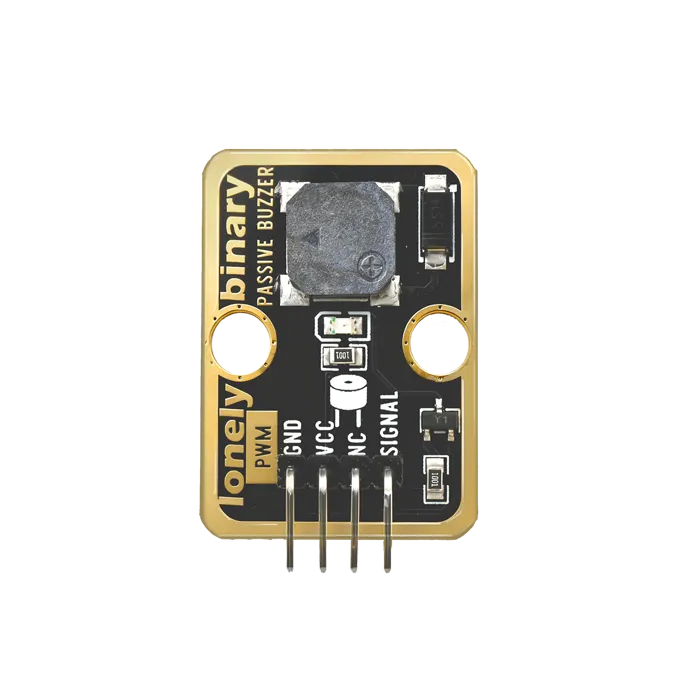
Passive Buzzer
A speaker with no oscillator of its own, so you choose the frequency. This is the one that plays tunes.