displays
7 pages across tutorials, modules, pinouts and guides.
0.56-inch 7-Segment Digits with a 74HC595 Driver Board
A 24-pack of 0.56" seven-segment digits and twelve 74HC595 driver boards: three wires instead of eight, which digit is common cathode and which is common anode, how the ten pins line up, and the current limit that bites on 8.
10-Segment LED Bar Graph Display
Ten independent LEDs in one 20-pin package, with a resistor board that puts 220 Ω in front of each. Which way round it goes, why LOW lights a segment, and what ten of them at once costs an Arduino.
1602 I²C LCD Display Module, 16×2 Blue
A 16 × 2 character display with the I²C chip on the board rather than on a backpack. Four wires, address 0x27 by default, three solder pads to change it, and a contrast trimmer that explains most blank screens.
32x8 LED Matrix with MAX7219, 3-Pack
Four 8x8 squares in one strip, 256 LEDs, three signal wires. What the pads are called, why the sketch has to say four, and what to do about a 3.3 V board on a chip that wants 3.5 V.
MAX7219 Vintage Tube LED Clock Kit
Eight 0.28-inch digits on a MAX7219, in a glass tube with a cork. Three displays arrive built and three arrive as pieces — a driver board and two four-digit panels, in red or blue, with a colon or with decimal points.
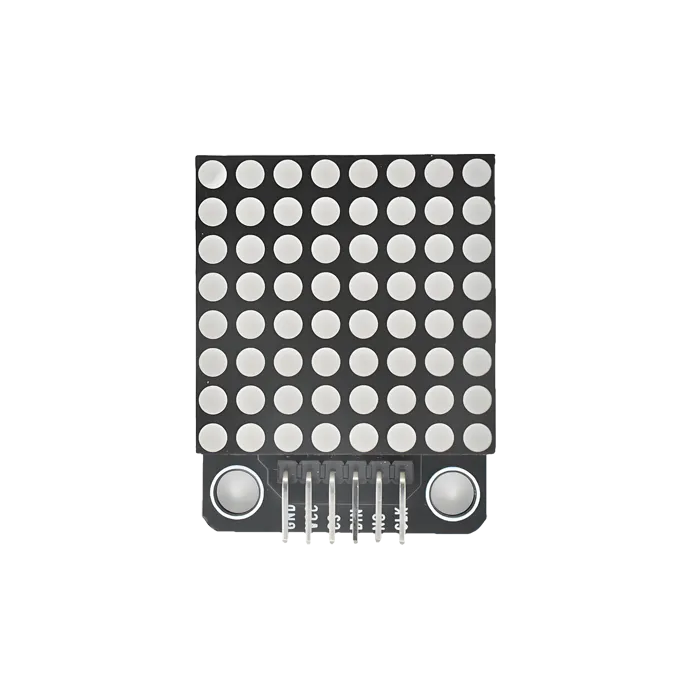
8x8 LED Matrix
Sixty-four LEDs and a MAX7219 that scans them for you. Two boards share this page — the TinkerBlock TK52 and the chainable module that comes three to a box — and only one of them can be chained.
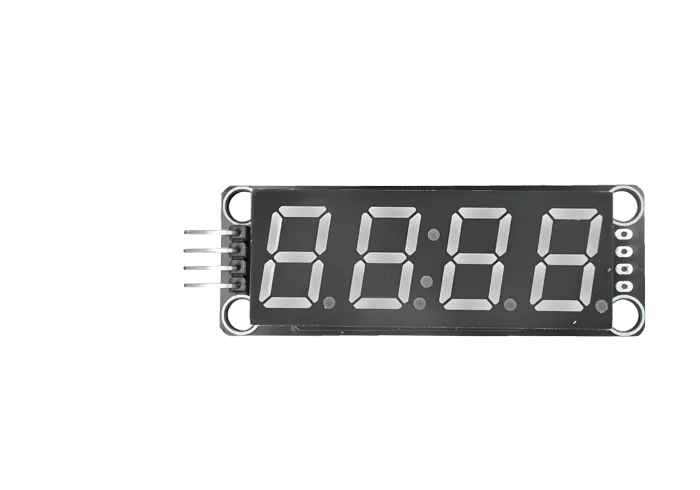
TM1637 4-Digit Display (0.56 inch)
Four seven-segment digits on two ordinary pins. The clock set with its colon, the digit set with decimal points, the TinkerBlock TK51, and the one bit that behaves differently on each.