Power
Batteries, regulators, solar and deep sleep. The difference between a project that runs on a bench and one that runs for a month in a shed.
INA219 and INA3221 Current Monitors: shunt, range and wiring
Two I²C current and voltage monitors: the TK119 with one INA219 on a 100 mΩ shunt, and the INA3221 with three channels on 50 mΩ. What the chip measures and what it works out, why the two resistors differ, the range and step each one gives, and the wiring for both.
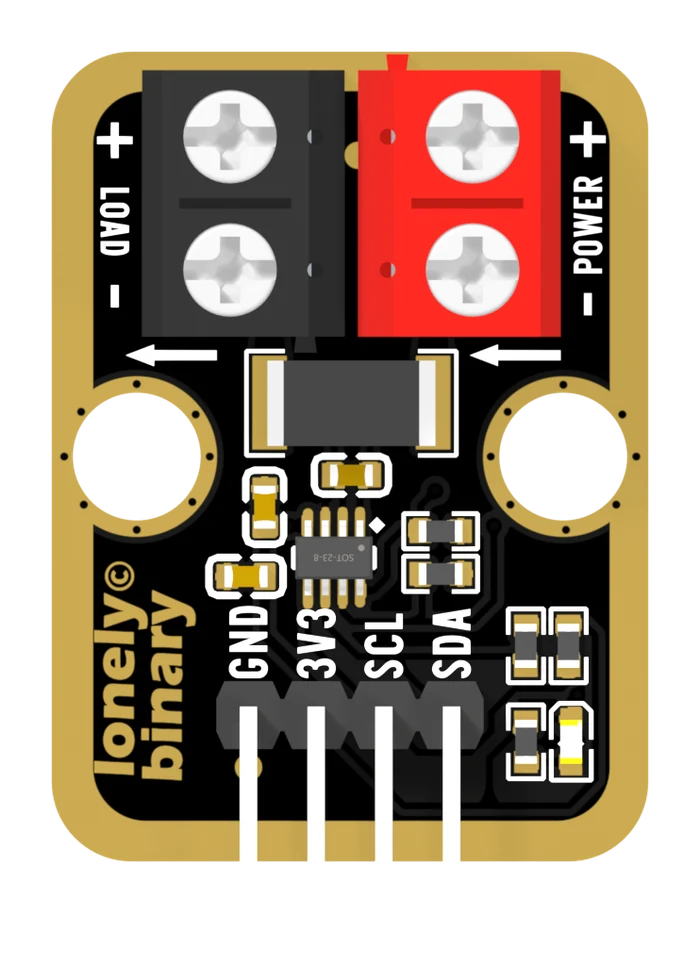
INA219 Current Monitor
A 100 milliohm resistor in the positive wire and a chip that reads the millivolts across it. Current, voltage and power over I²C, up to 3.2 A on a rail of up to 26 V.
USB-C PD Trigger, 100 W Decoy 5–20 V
A USB-C charger holds 9, 12, 15 and 20 V and hands you 5 V until something asks. This board asks. Three levers set the voltage, a CH224K does the negotiating, and a screw terminal brings it out.
USB-C Breakout Board with 5.1 kΩ CC Resistors
A USB-C socket that a modern charger will actually talk to, with both CC pull-downs already fitted. What the resistors do, which of the six pads is which, how much current you may take, and the one thing the board can never be.
ESP32 LiPo Dev Kit: 3 Boards with a LiPo Charger, and 3 Shields
Three classic ESP32 boards that charge a lithium cell from USB-C and run from it when the cable comes out, and three shields to wire them on. Which cell, which socket, which way round, and how long a cell lasts.
AMS1117 LDO Regulator Modules: 3.3 V and Adjustable
Eighteen fixed 3.3 V boards and six adjustable ones that turn a higher supply into a steady lower voltage. What to feed them, which pin is which, how much current before heat stops them, and how to set the adjustable board.
35. Voltmeter
Use analog input to measure voltage and convert to real value; outcome: serial shows voltage (V); with the module’s divider you can display about 0–25V.
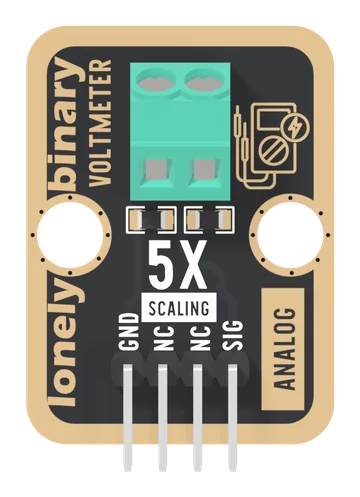
Voltmeter
A 30 kΩ and 7.5 kΩ divider behind a two-screw terminal: SIG is exactly one fifth of the input, so an analog pin can read up to 25 V on a 5 V board and about 15.5 V on a 3.3 V one. DC only, measured from GND.