What a base does
An ESP32 has thirty-eight pins in two rows, and a breadboard leaves you one spare hole beside half of them. A base gives every pin somewhere to go, holds the board down, and adds a ribbon socket for a display.
The problem with a bare board
The ESP32 arrives with its pins soldered on: nineteen down each long edge, thirty-eight in total. That is a lot of pins, and every one of them is a single piece of metal. Push a jumper onto GPIO 25 and GPIO 25 is spoken for.
The usual answer is a breadboard, and it half works. The two rows of pins are 25.4 mm apart — exactly ten holes on a 2.54 mm grid — and a breadboard is eleven holes wide from one outside column to the other.
Ten into eleven leaves one column. Not one each side: one, on whichever side you happened to line the board up with. The other nineteen pins are under the board with nothing beside them, and the only way to reach one is to pull the board out and put it back a column over.
What a base adds
A base is a second board with two sockets on it. The ESP32 drops in, and every pin it has comes out again somewhere you can get at.
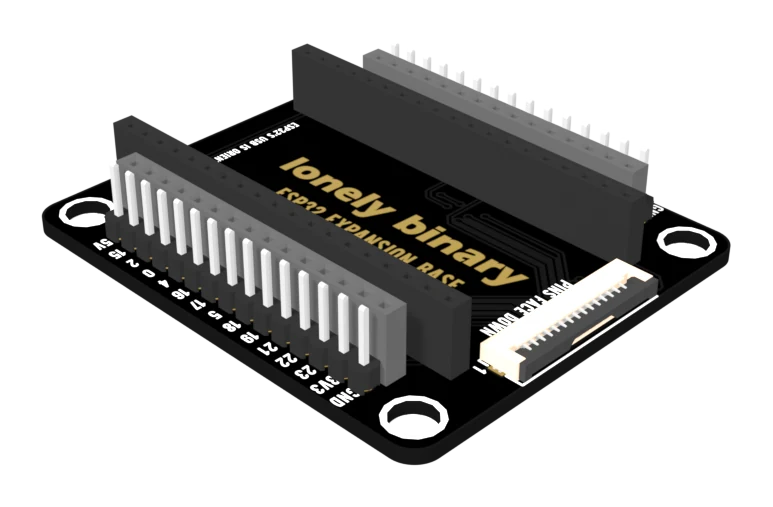
Three things come with that on all four bases in this book, and a fourth on two of them:
Somewhere to screw it down. Four mounting holes at the corners, which is four more than the bare board has. The back of every base says the holes work with major brand bricks, so a base is also something a child can build into something.
A ground and a 3.3 volt supply on both sides, so a sensor on the left and a sensor on the right each have their own, and neither needs a wire crossing the board.
A fifteen-way display connector, on the top face of every base, for a ribbon instead of eight jumper wires. That one gets a page of its own.
And on the two 2.54 mm bases only: every signal twice. Their edges carry two contacts per row, so one connection can stay put while you move the other. The two terminal bases give each signal one terminal, which is the price of a connector that holds bare wire.
What a base does not add
No regulator, no protection, no level conversion. The 3.3 volts at the edge is the dev board's own regulator output, and the 5 volts is USB power one diode down. If you short a pin at the edge, you have shorted the pin.
Three of the four bases are, electrically, a set of wires. The fourth — the PinPulse base — adds twenty-four LEDs and four buffer chips to drive them, and is built the way it is precisely so that those twenty-four additions stay out of your signals.
When it does not work
Not for the board itself, which is the point — the base is what the board plugs into. A breadboard is still the easiest place to build a circuit out of loose parts, and a few jumpers from the base's edge will reach it.
These four are cut for the 38-pin Lonely Binary ESP32, nineteen pins a side and 25.4 mm between the rows. A 30-pin or 36-pin board from elsewhere has a different pin count and often a different width, so it will not seat. Count the pins along one edge before you push.
Three of the four do nothing but carry copper: every rail and every signal at the edge is the ESP32's own pin, arriving through the socket. The PinPulse base is the exception, and even there the extra parts sit beside your signals rather than in them.
The board drops in one way. The other way connects 5 V to ground.
Only one way round →Edit this page — content/books/esp32-base/what-a-base-does.mdx
Questions about this product
See what other owners have asked, and read their solutions.
This page covers several products. Choose yours to see the right discussions.
Discuss this article
Ask about this page. The answer stays here, on the page it belongs to, for whoever hits the same wall next.