TXB and TXS: same shape, opposite rules
The TXB0108 and TXS0108 share a board and a pinout. One pushes signals and cannot stand pull-up resistors; the other has pull-up resistors built in. Mixing them up is the commonest reason an I²C sensor vanishes.
Both sense direction by themselves
Both chips watch every channel. When one side starts to change, the chip gives the other side a short, hard push to make the edge sharp. There is no direction pin. Where they differ is what happens between edges.
TXB: pushes, then holds weakly
Between edges, the TXB holds each line with a weak drive of about 4 kΩ. Anything driving a TXB pin has to be stronger than that — TI asks for at least 2 mA, which every microcontroller output manages easily.
A pull-up resistor cannot. It is too weak to win against the TXB's hold, so the two fight. TI's datasheet says any pull-up on a TXB line must be over 50 kΩ, and names I²C and 1-Wire as jobs not to use it for. A button wired with a pull-up has the same problem.
TXS: pull-ups inside
The TXS has pull-up resistors built in: 4 kΩ while it passes a HIGH, 40 kΩ while it passes a LOW. So a bus that depends on pull-ups, like I²C, works through it. The price is speed on those lines: 1.2 Mbps, still three times faster than fast I²C. For driven signals the TXS is rated to 110 Mbps.
Try each chip on each kind of signal:
Read the silkscreen
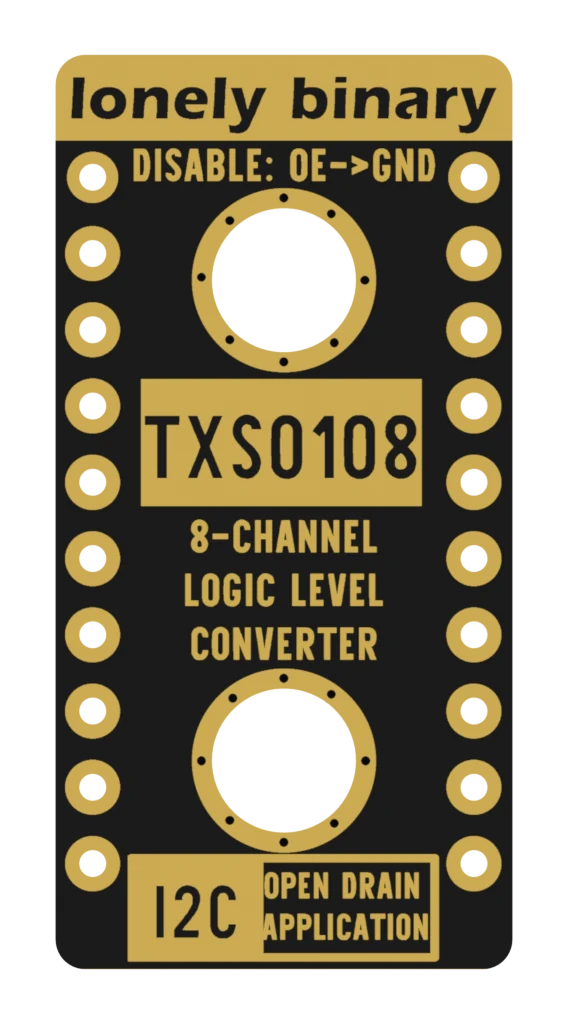
"Open drain" is the name for a line that devices only pull LOW, with a resistor supplying the HIGH — I²C, 1-Wire, a button. "Push pull" is a line driven both ways — SPI, serial, an LED strip's data. That single word on the back of the board is the choice between them.
Keep the wires short
The push each chip gives an edge lasts only tens of nanoseconds, and TI recommends short connections for both, and rates the TXB for loads up to 70 pF. Breadboard jumpers are fine. A long cable is where they can start to misbehave, and at slow speeds a MOSFET board copes with that better.
When it does not work
Expected — the TXB is the wrong board for I²C, and TI's datasheet says so. The sensor module's pull-up resistors fight the TXB's own weak hold on the line. Move the same two wires to a TXS0108 or a 2-channel MOSFET board.
Both chips give every edge a short, hard push, and on a long wire the reflection can arrive back while that push is still going and trigger another. TI recommends short connections for both chips. Shorten the wire; for a long cable at slow speed, the MOSFET board is the forgiving one.
Read the title printed at the top of the component side: TXB0108 [SPI] or TXS0108 [I2C]. The back says it again in the bottom box: SPI PUSH PULL APPLICATION or I2C OPEN DRAIN APPLICATION.
You can, and TI says they can help a slow line rise faster, but you do not have to — the chip already has them. For a normal I²C bus, the modules' own pull-ups plus the TXS's internal ones are enough.
Why the MOSFET boards are perfect for I²C and too slow for fast SPI, on one slider.
The slow rising edge →Edit this page — content/books/llc/txb-and-txs.mdx
Questions about this product
See what other owners have asked, and read their solutions.
This page covers several products. Choose yours to see the right discussions.
Discuss this article
Ask about this page. The answer stays here, on the page it belongs to, for whoever hits the same wall next.