What a converter does
Two supplies in, the same signal out at a different height, in either direction. That is the whole job, and seeing its shape once makes every wiring question in this book easy.
Two sides, two supplies
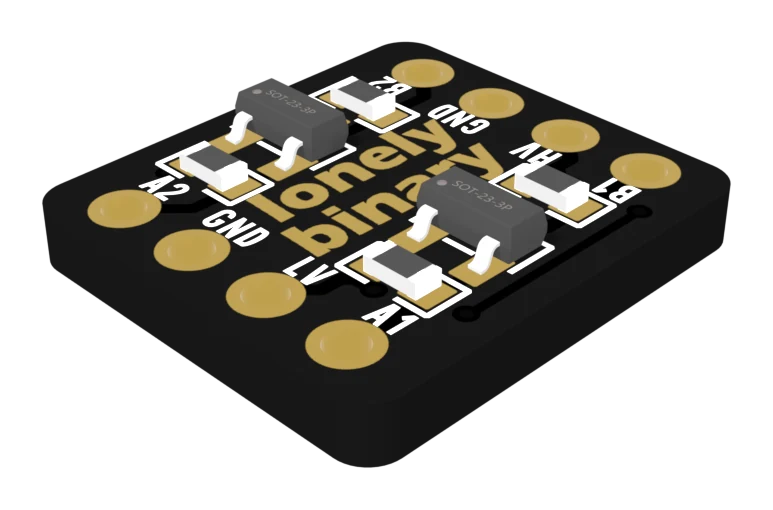
Every board in both boxes has two sides. The A side is powered at 3.3 V and connects to your 3.3 V board. The B side is powered at 5 V and connects to the 5 V part. Those two supplies are how the converter knows what HIGH means on each side.
No direction pin
A HIGH that goes in on A comes out as a HIGH on B, and the other way round. Whichever side pulls the wire first is the one being copied. That is what lets an I²C sensor answer on the same wire the board used to ask the question.
What it does not do
- It does not power anything. LV and HV tell the converter the two voltages. The 5 V part still needs its own 5 V.
- It does not drive loads. An LED, a relay or a motor needs far more current than a converter channel gives. Converters carry signals.
- It does not change your data. It copies each HIGH and LOW across. It does not know what they mean, which is why one board works for any protocol it is fast enough for.
When it does not work
HV is an input, not an output. The converter uses it to learn what 5 V is and draws almost nothing from it. Feed the 5 V part from a real 5 V supply — often the same wire that goes to HV.
The channels are for signals, not loads. On a MOSFET board a HIGH arrives through a 10 kΩ resistor, which is half a milliamp at 5 V — far too little for an LED. Drive LEDs, relays and motors from their own driver, and use the converter only for the signal that tells the driver what to do.
No. A bidirectional channel carries a one-way signal perfectly well — it simply never gets asked to go the other way. Every board in both boxes is fine for this.
Three sizes of one circuit, two chips on one footprint, and one rule that holds for all of them.
The five boards →Edit this page — content/books/llc/what-a-converter-does.mdx
Questions about this product
See what other owners have asked, and read their solutions.
This page covers several products. Choose yours to see the right discussions.
Discuss this article
Ask about this page. The answer stays here, on the page it belongs to, for whoever hits the same wall next.