
sensors
13 pages across tutorials, modules, pinouts and guides.
Door Sensor
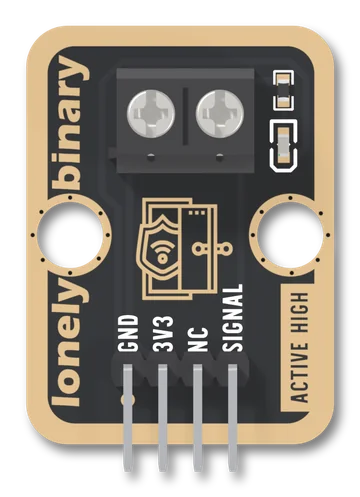
A TinkerBlock board that takes the two bare wires of a magnetic door or window sensor on a screw terminal and puts it between VCC and SIGNAL. A closed sensor reads HIGH; open, SIGNAL floats, because the board has no pull-down, so you set one in setup(). The red LED lights while the sensor is closed: it is not a power light.
3-Axis Accelerometer
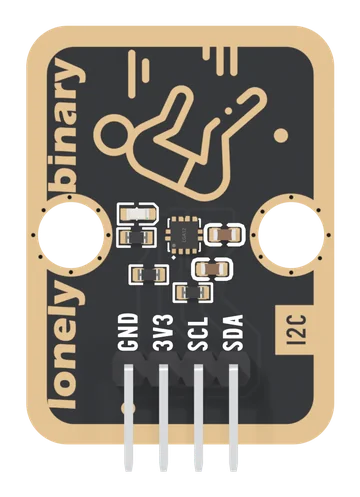
A Silan SC7A20H accelerometer on a TinkerBlock board: tilt, orientation, shakes and drops over two shared I²C wires, at address 0x19, with the pull-ups fitted. 3.3 V only.
SHT31 Temperature and Humidity Sensor
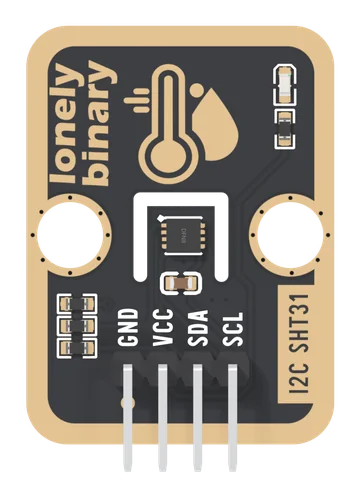
A Sensirion SHT31 on a TinkerBlock carrier: two numbers over two shared wires, calibrated at the factory, with the pull-ups already fitted and two jumpers on the back that set the address and take them away again.
DHT11 Temperature and Humidity Sensor
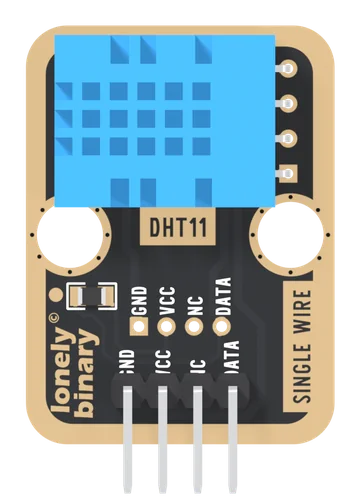
A DHT11 on a TinkerBlock board, the TK38: temperature from 0 to 50 °C to ±2 °C and humidity from 20 to 80 % to ±5 %, in whole numbers, on one data wire. The 10 kΩ pull-up is fitted, so it is three wires and one library. Feed VCC what your board's pins run at: the pull-up ties DATA to it.
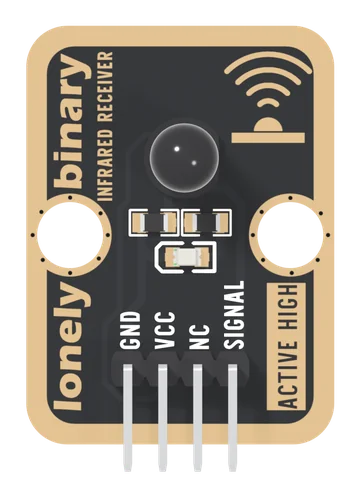
Infrared Receiver
An infrared light sensor on a TinkerBlock board: an Everlight PT334-6B phototransistor in a black 5 mm package and a 10 kΩ load, so SIGNAL is an analog voltage that rises with how much infrared arrives, steady or flashing. The partner of the TK63 for a break-beam. It is not the TK15 IR Receiver: it decodes no remote, and the TK15 ignores steady light.
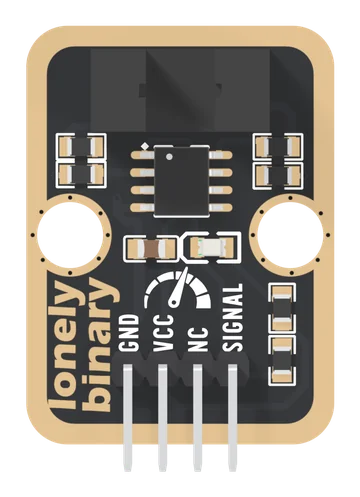
Infrared Speed Sensor
A GK105A slotted optical switch on a TinkerBlock board: an infrared beam across a 5 mm slot, judged by an LM393 comparator. Something in the slot reads HIGH; a clear slot reads LOW and lights a red LED. Put a slotted disc through it and count pulses for rpm, up to about 1,900 a second. VCC must be your board's logic voltage.
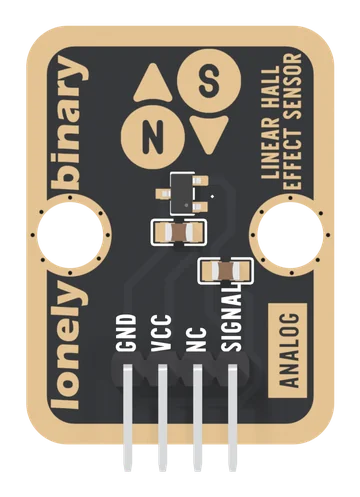
Linear Hall Effect Sensor
An SS49E-type linear Hall sensor on a TinkerBlock board: an analog voltage that rests at half of VCC with no field and moves about 3.25 mV per gauss at 5 V, up for one pole and down for the other. It tells you how strong a magnetic field is and which way it points. VCC must be your board's logic voltage, and it is not a current sensor on its own.
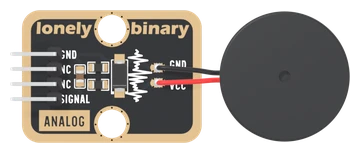
Piezo-Ceramic Sensor
A 22 mm piezo disc on a TinkerBlock board that needs no supply: two wires, GND and SIGNAL. A tap makes a hump on SIGNAL that rises in about a millisecond and drains in about a tenth of a second, taller for a harder tap. It senses change, not weight, and nothing on the board holds SIGNAL below 3.3 V.
Reed Switch
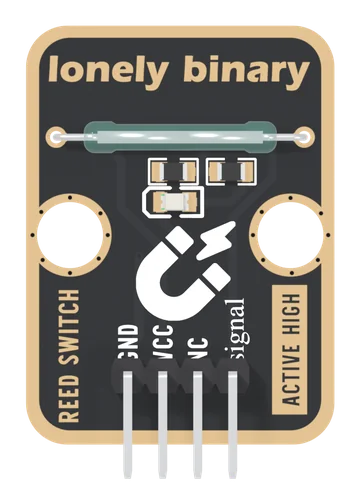
A glass reed switch on a TinkerBlock board: two blades that a magnet pulls shut, from either pole, with no power needed to sense. It sits between VCC and SIGNAL with a 10 kΩ pull-down, so a magnet reads HIGH, and a red LED lights while it is closed. It draws nothing while open, and VCC must be your board's logic voltage.
Reflective Optical Sensor
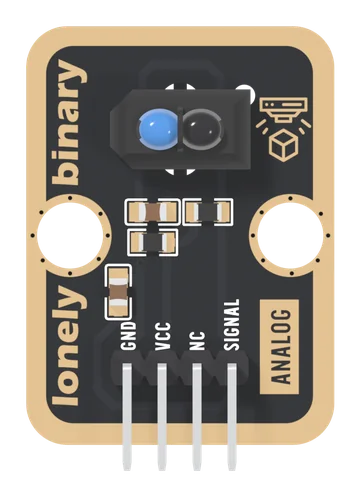
A Vishay TCRT5000 on a TinkerBlock board: an infrared emitter that is always on and a phototransistor beside it, both looking out of the front. Infrared coming back pulls SIGNAL down from VCC through 4.7 kΩ, so white paper reads low and black tape or open air reads high. Analog only, best at 2.5 mm, and VCC goes to your board's logic voltage: 3V3, or 5V on an Uno.
Steam Sensor
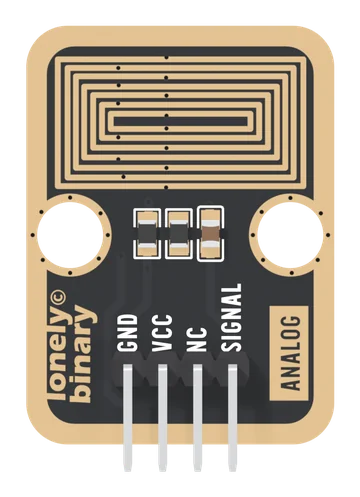
A TinkerBlock board that reads water on its surface: seven nested loops of bare gold, every other one on VCC, the rest held at 0 V by a 1 MΩ. Condensed steam, breath or a drop across the loops makes a divider, and SIGNAL rises from 0 V towards VCC. It is an analog output, it does not sense humidity in the air, and VCC must be your board's logic voltage.
Tilt Sensor
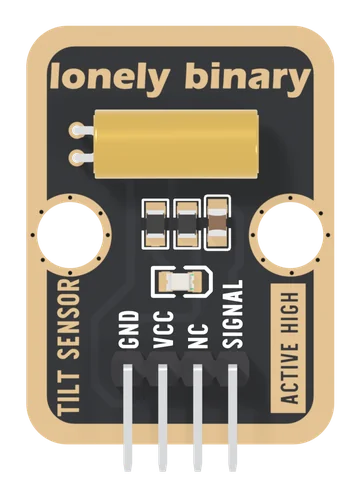
An SW-520D ball tilt switch on a TinkerBlock board: two steel balls in a brass can that close the switch when its lead end, the board's left edge, is the lower one. It sits between VCC and SIGNAL with a 10 kΩ pull-down and a 100 nF, so left edge down reads HIGH, and a red LED lights while it is closed. It draws nothing while open, reads nothing definite near level, and VCC must be your board's logic voltage.
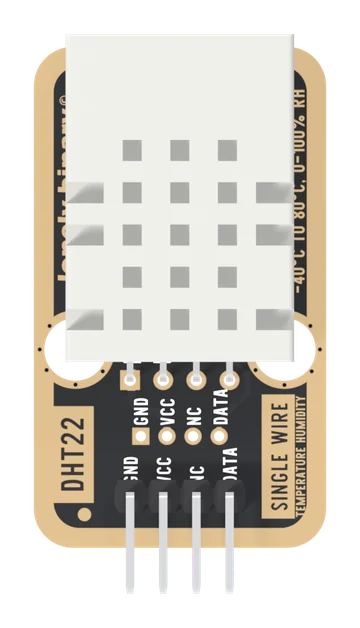
DHT22 Temperature and Humidity Sensor
A DHT22 on a TinkerBlock board, the TK39: temperature from −40 to 80 °C to ±0.5 °C and humidity from 0 to 100 % to ±2 %, in tenths, on one data wire. The 10 kΩ pull-up is fitted, so it is three wires and one library. Feed VCC what your board's pins run at, and read it no more than once every two seconds.