
A frame without a cable.
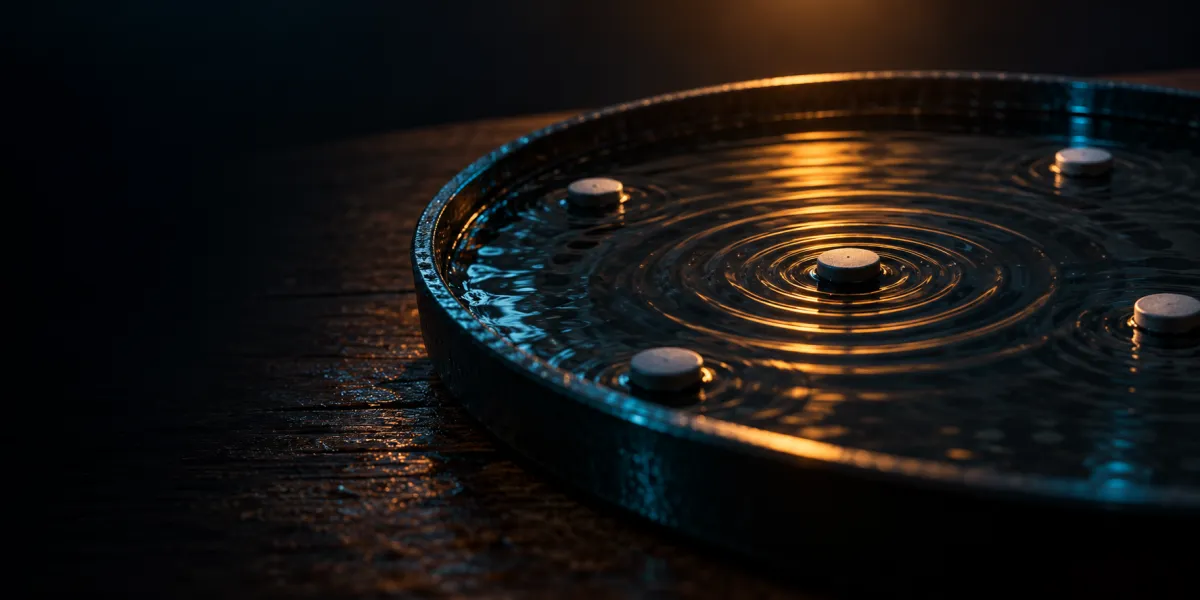
Wi-Fi sends the same kind of frame Ethernet does, through the air to everyone in range. Shown as a ripple tank, floats on dark water sending rings to each other, with the channels on a strip along the rim and the signal on a meter, and then the ESP32 itself on the bench. Thirteen short lessons, each with a bench you can press, on a laptop, a phone or in a VR headset.
A frame sent through the air to everyone in range, radio waves and the channels of the 2.4 GHz band, and why signal is not a bar count.
Beacons and scans, the stages of joining from authentication to an IP address, and the three roles: station, access point, or both.
Taking turns on one channel with a random backoff, stations that cannot hear each other, and the trade between a robust rate and a fast one.
A station that sleeps between beacons while the access point holds its frames, and what Wi-Fi security hides and what it does not.
The ESP32 on the bench, its band, its antenna and its power, and how to find the fault when it says connected but nothing works.
Electricity
Volts, current, resistance and the mistakes that kill parts. 35 pages, true of every board.
35 articles →The other fundamentals trackPower and protection
Fuses, ideal diodes, TVS and lithium cells — every part that sits between a supply and something you would rather not replace. 13 pages, with part numbers.
13 articles →The other fundamentals trackI2C
The two-wire bus nearly every sensor module speaks, from the beginning. Every lesson has a bench in 3D and in a VR headset.
12 articles →The other fundamentals trackMQTT
How a reading gets from a sensor to a phone, a laptop and a lamp without any of them knowing the others. Every lesson has a bench in 3D and in a VR headset.
10 articles →The other fundamentals trackSPI
The four-wire bus that chip after chip uses when it needs to be fast: a clock, two belts of bits, and a light that says who is listening. Every lesson has a bench in 3D and in a VR headset.
14 articles →The other fundamentals trackScreens
Every way a screen is fed, from a two-wire OLED to an eDP laptop panel: how much data a picture is, where the picture lives, and what has to keep moving. Every lesson has a bench in 3D and in a VR headset.
16 articles →The other fundamentals trackTCP and UDP
What a network adds to your data and what it leaves out: one-line cards that may be lost, and a novel cut into numbered strips that is pasted back together. Every lesson has a bench in 3D and in a VR headset.
12 articles →The other fundamentals trackUART
How two devices send bytes down a wire with no clock between them, only an agreement made beforehand: the idle line, the start bit, the data bits, baud, and what happens when the two sides disagree. Every lesson has a bench in 3D and in a VR headset.
12 articles →The other fundamentals trackRS-485 and Modbus
How a serial line is made to carry a long run and a crowd: a difference between two wires, a trunk with many taps, one driver at a time, the ends, and the Modbus conversation on top of it. Every lesson has a bench in 3D and in a VR headset.
12 articles →The other fundamentals trackCAN bus
How many devices share one pair of wires with no master: a hall of desks that shout or stay quiet, who speaks first, how a message is built and checked, what goes wrong, and the two ends of the rail. Every lesson has a bench in 3D and in a VR headset.
12 articles →The other fundamentals trackEthernet
How a cable carries a network: one shared channel and its collisions, what a frame holds and who it is for, hubs and switches, how a link comes up, the MAC, the PHY and RMII, and the three ways an ESP32 gets Ethernet. Every lesson has a bench in 3D and in a VR headset.
12 articles →The other fundamentals trackWorkshop
The hand skills. Soldering a joint that lasts, and reading the ones that will not. 2 pages, no circuit required.
2 articles →Next, in the ESP32 bookWires on the board
How two chips agree on what a line means, sorted by what it costs you in pins
9 articles, no board required →Next, in the ESP32 bookMessages on the network
Once there is no wire left to agree about, the question is who talks first
5 articles, no board required →