beginner
21 pages across tutorials, modules, pinouts and guides.
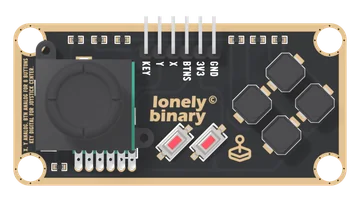
Slim Joystick
A thumb stick and six buttons on one long TinkerBlock board, on six pins. X and Y are two potentiometers, read on analog pins; KEY is the click under the stick, LOW at rest and HIGH when pushed; and all six buttons share BTNS, one analog pin, through a ladder of 10 kΩ resistors that gives each its own voltage. One button reads at a time.
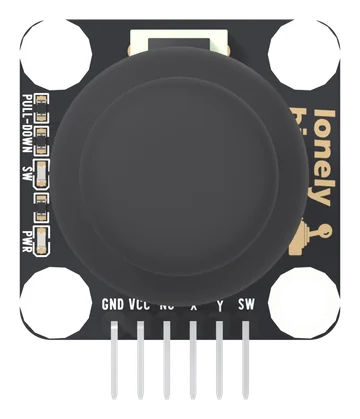
Dual Axis Joystick
A thumbstick on a square TinkerBlock board, on six pins: GND, VCC, NC, X, Y and SW. X and Y are two potentiometers from VCC to GND, read on analog pins; SW is the click under the stick, LOW at rest and HIGH when pressed, with its own pull-down. Every line reaches VCC, so VCC is your board's logic voltage. A PWR light and an SW light show power and each click.
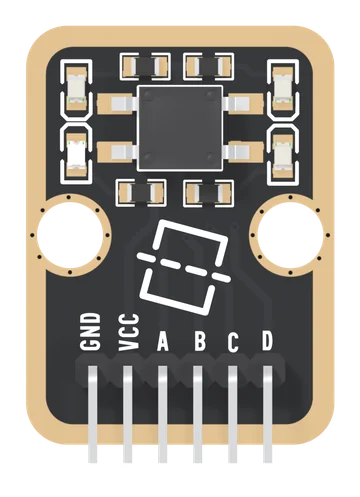
4-Direction Tilt Sensor
One metal roller in a square switch with four corner contacts, on a TinkerBlock board: tip an edge down and the roller joins that side's two lines. Your board finds which pair by holding one line LOW and reading who follows. Four answers and none, no angle, and four red LEDs that light when a line is held LOW.
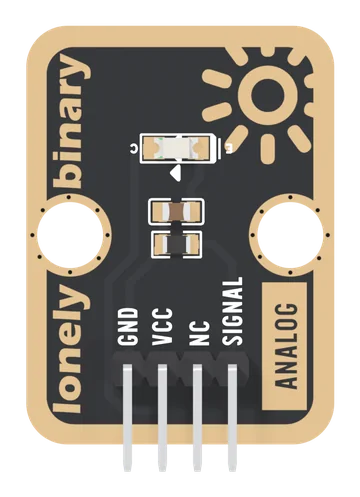
Ambient Light Sensor
A phototransistor and a 4.7 kΩ resistor on a TinkerBlock board: light makes a current, the resistor turns it into a voltage, and SIGNAL rises with the light. A lit room reads low on the scale, bright light flattens just under VCC, and it sees near infrared best.
Analog Microphone
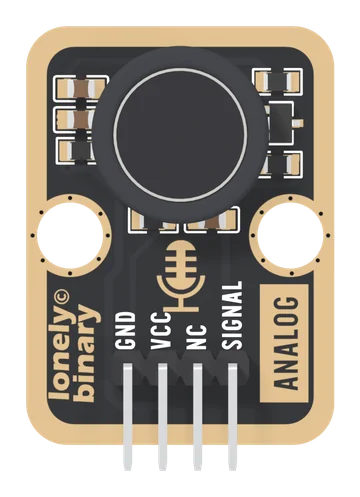
An electret capsule and a one-transistor amplifier on a TinkerBlock board. SIGNAL rests at a level set by the transistor's gain and swings above and below it with sound, in a band of roughly 75 Hz to 1 kHz. Read the peak-to-peak over 50 ms: it hears claps, knocks and loud voices, and it is not a recording microphone.
Analog to Digital Signal
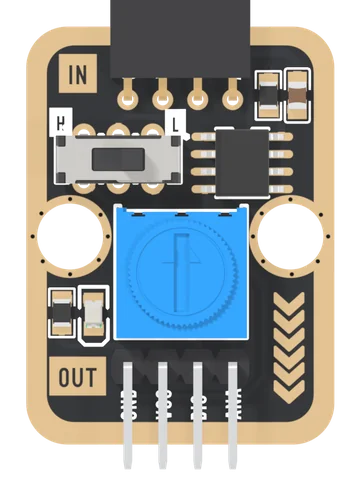
An LM393 comparator on a TinkerBlock board: plug an analog block into the IN socket, set a threshold with the blue knob, and DIG tells your board whether the block's voltage is above or below it. The block's own voltage passes through on ANA, and a slide switch printed H and L turns the answer over.
Collision Sensor
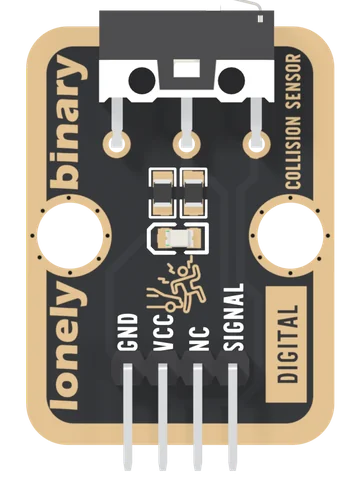
A lever microswitch with its 10 kΩ pull-down and a red hit light already fitted: SIGNAL reads HIGH while the lever is pushed in. The bumper for a TinkerBlock robot, and the sense that never reports a wall that is not there.
Disc Potentiometer
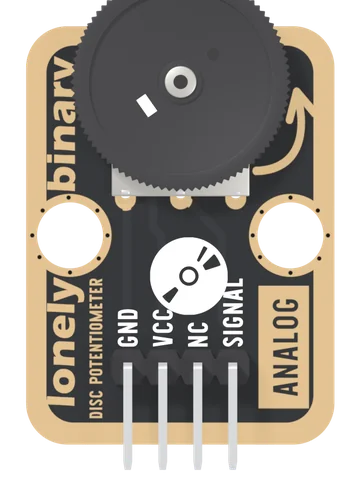
A 10 kΩ thumbwheel potentiometer wired as a voltage divider: turn the wheel and SIGNAL runs from 0 V to VCC, read by one analog pin. The wheel lies flat and overhangs the board's edge, so a thumb turns it from the side.
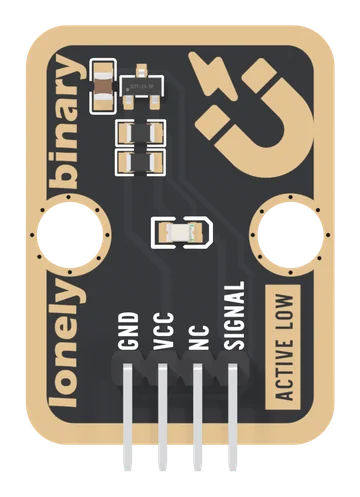
Hall Effect Sensor
An omnipolar Hall switch on a TinkerBlock board: bring either pole of a magnet near and SIGNAL goes LOW and a red light comes on. No contact to wear out, it works through plastic, and it looks at the field every 22 ms, so it is made for doors, lids and slow wheels.
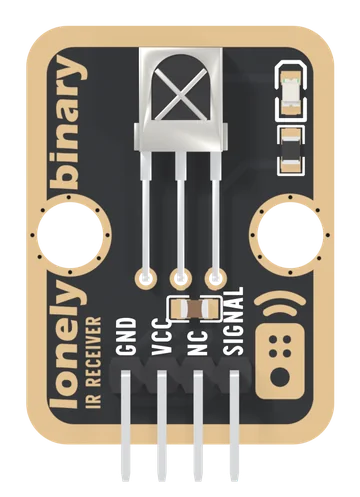
IR Receiver
A Vishay TSOP18138 38 kHz infrared receiver on a TinkerBlock board: SIGNAL idles HIGH and goes LOW while a remote sends, and the IRremote library turns those lows into an address and a command.
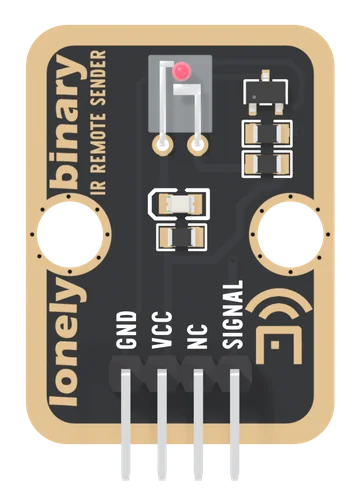
IR Sender
An Everlight IR908-7C 940 nm infrared LED, switched by a transistor, on a TinkerBlock board. SIGNAL HIGH lights it; your microcontroller makes the 38 kHz carrier, and one 150 Ω resistor decides how far it reaches.
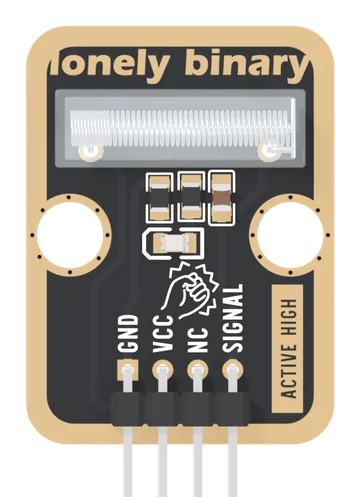
Knock Sensor
A spring vibration switch with its 10 kΩ pull-down, a 100 nF capacitor and a red flash light already fitted: SIGNAL goes HIGH for a moment each time a knock swings the spring onto its rod. A tap on a table as a button, a door that was knocked, a box that was dropped.
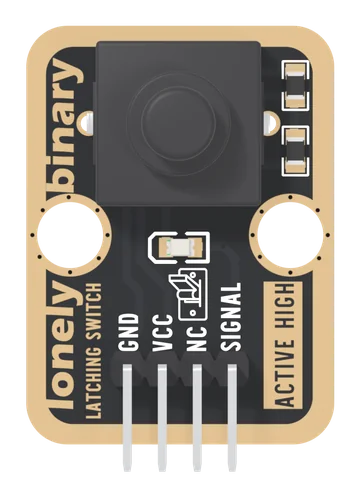
Latching Button
A push-on, push-off switch with its pull-down and a red indicator LED already fitted: one press turns SIGNAL HIGH and it stays HIGH, through a reset or a power cut, until the next press.
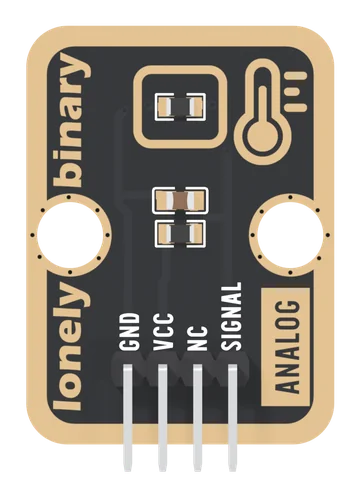
NTC Thermistor
A 10 kΩ NTC thermistor in a divider with a fixed 10 kΩ: SIGNAL is half of VCC at 25 °C and falls as it warms. Read it on any analog pin and turn it into degrees with two lines of arithmetic.
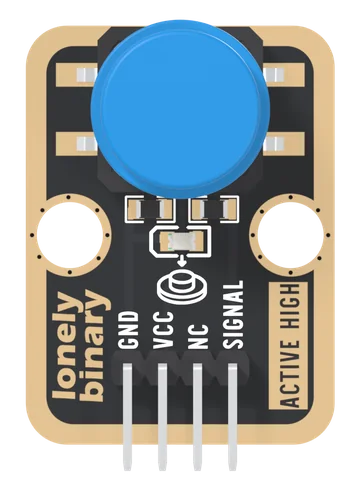
Push Button
A 12 mm momentary push button with its 10 kΩ pull-down and a red press light already fitted: SIGNAL reads HIGH while the button is down. The first input in the kit, and the module that teaches debouncing.
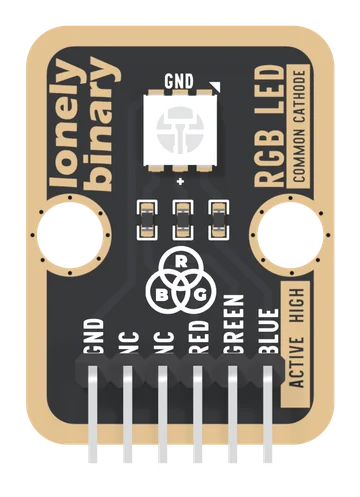
RGB LED
A red, a green and a blue LED in one 5 mm package, each with its own 1 kΩ resistor and its own pin, joined at a common cathode. Three PWM pins mix any colour, and the handbook works out why three equal numbers are not white.
Rotary Potentiometer
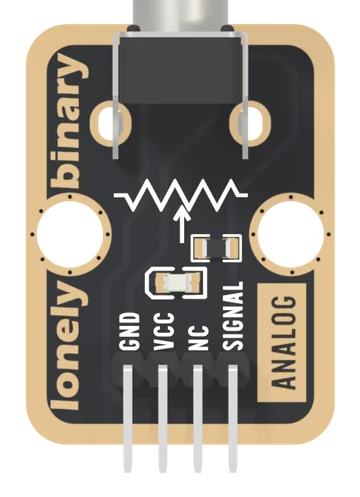
A 10 kΩ linear potentiometer with a knob, wired as a voltage divider: SIGNAL gives 0 V to VCC as you turn. A red LED on the wiper glows as you turn up, and it bends the upper part of the reading: hard on 5 V, less on 3.3 V.
Traffic Light
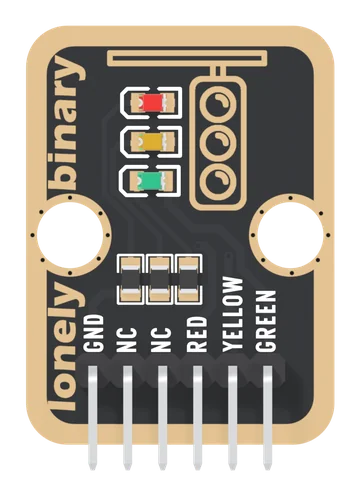
Red, yellow and green LEDs, each with its own 1 kΩ resistor and its own pin, sharing one GND: three digital outputs, and the first sketch that has to remember what it is doing.
Vibration Motor
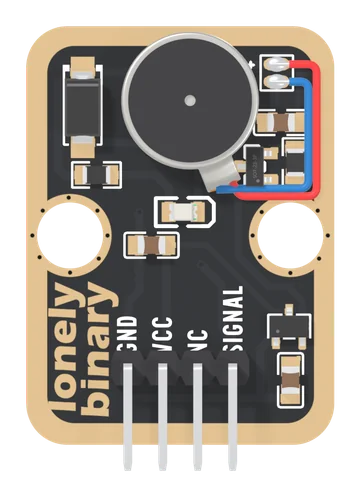
A 10 mm coin vibration motor on a TinkerBlock board, switched by a MOSFET and fed from the board's own 3.3 V regulator. SIGNAL HIGH buzzes, LOW stops, analogWrite sets the strength. VCC only feeds the regulator, so 5V on VCC is safe beside a 3.3 V board, and 3V3 or 5V both give the motor about 3.3 V.
Voltmeter
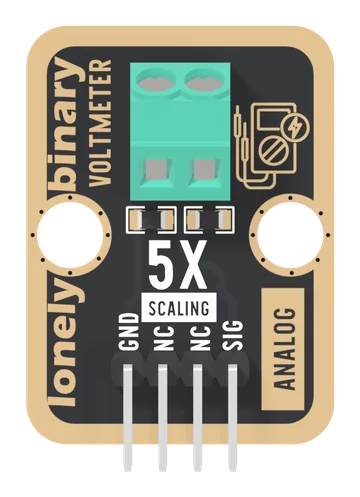
A 30 kΩ and 7.5 kΩ divider behind a two-screw terminal: SIG is exactly one fifth of the input, so an analog pin can read up to 25 V on a 5 V board and about 15.5 V on a 3.3 V one. DC only, measured from GND.
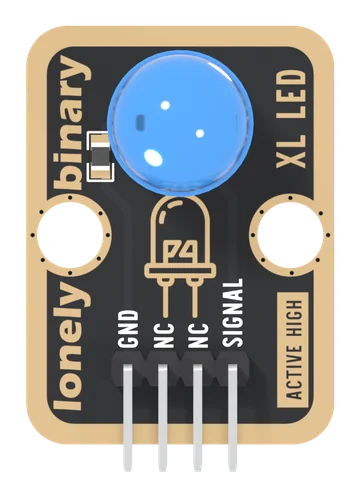
XL LED
A 10 mm blue LED with its 150 Ω resistor already fitted, driven by one pin: the first output most people ever drive, and the light every later lesson uses to show that something happened.