What is on it
A 12 mm electromagnetic buzzer with its own oscillator inside, so it needs only power to sound at about 2.4 kHz. An S8050 transistor switches it, a 1 kΩ feeds the transistor's base, an SS14 diode sits across the buzzer, and a red LED lights while it is driven. The paper seal on top is there for washing the board, and comes off.
Six parts
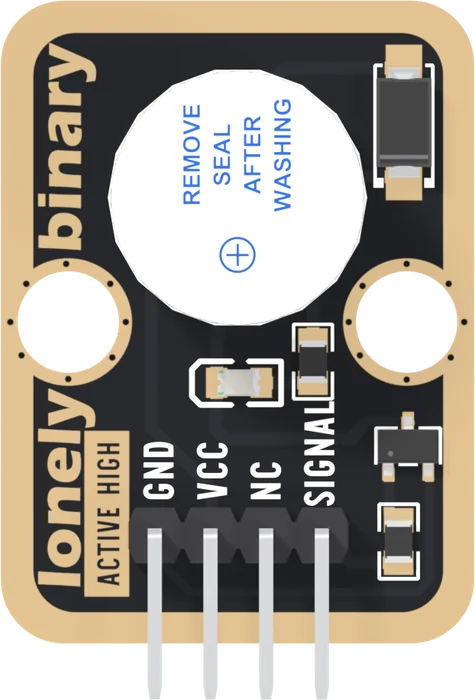
The round can takes up most of the board. The rest is its driver: a transistor, two resistors, a diode and an LED.
An active buzzer
The buzzer is a Huawha TMB12A05, 12 mm across and 9.5 mm tall. Its datasheet calls it an electromagnetic active buzzer. Electromagnetic: a coil inside moves a thin metal disc, which is what you hear. Active: the circuit that drives the coil back and forth is inside the can too, so the buzzer makes its note from a plain DC supply. Connect 5 V and it sounds; take it away and it stops.
The note is 2400 Hz, give or take 300 Hz between parts. A test report in the datasheet measured ten of them at 2399 to 2416 Hz. The page this book replaces called it a piezo element and put its note near 2 kHz; the datasheet says otherwise on both counts.
The passive buzzer, TK37, has no oscillator. Your sketch has to make the note, and in return it can make any note. Pick this one for a beep that takes one line of code, and that one for a tune.
The seal
The white paper disc printed REMOVE SEAL AFTER WASHING covers the sound hole while boards are cleaned after soldering. The buzzer still beeps with it on, but the datasheet warns that anything covering the hole can make the buzzer run unsteadily. Peel it off. For the same reason, tape over the hole is not a volume control.
The light
The LED runs from VCC through 1 kΩ to the transistor, beside the buzzer, so it lights only while SIGNAL is HIGH. It is red on the boards as shipped, though the BOM names a green part. It says the switch closed, not that the buzzer made a sound, and that difference is the most useful clue in when it does not beep.
When it does not work
Yes. It says REMOVE SEAL AFTER WASHING: it keeps cleaning fluid out of the buzzer while the board is washed after soldering. The buzzer still sounds with it on, but the datasheet warns that anything covering the sound hole can make it run unsteadily.
That is right. It is not a power light. It sits between VCC and the transistor, so it only lights while SIGNAL is HIGH and the buzzer is being driven.
No. The note comes from an oscillator inside the buzzer, 2400 Hz give or take 300 Hz from one part to the next. For tunes use the TK37 passive buzzer, which plays whatever frequency your sketch gives it.
What SIGNAL HIGH sets going, and why a 3.3 V pin is plenty.
A switch in the ground wire →Edit this page — content/books/active-buzzer/what-is-on-it.mdx
Questions about this product
See what other owners have asked, and read their solutions.
Active Buzzer
Loading discussions…
Discuss this article
Ask about this page. The answer stays here, on the page it belongs to, for whoever hits the same wall next.