What is on it
The panel's ribbon in a 12-way socket, a BSS138 transistor and two resistors that switch the backlight, 10 µF and 100 nF across 3V3, and two solder jumpers that ship open. No regulator, no level shifter. The glass is sold as 1.8-inch; its drawing measures the picture at 1.77 inches, 128 by 160 pixels.
A board that is mostly wiring
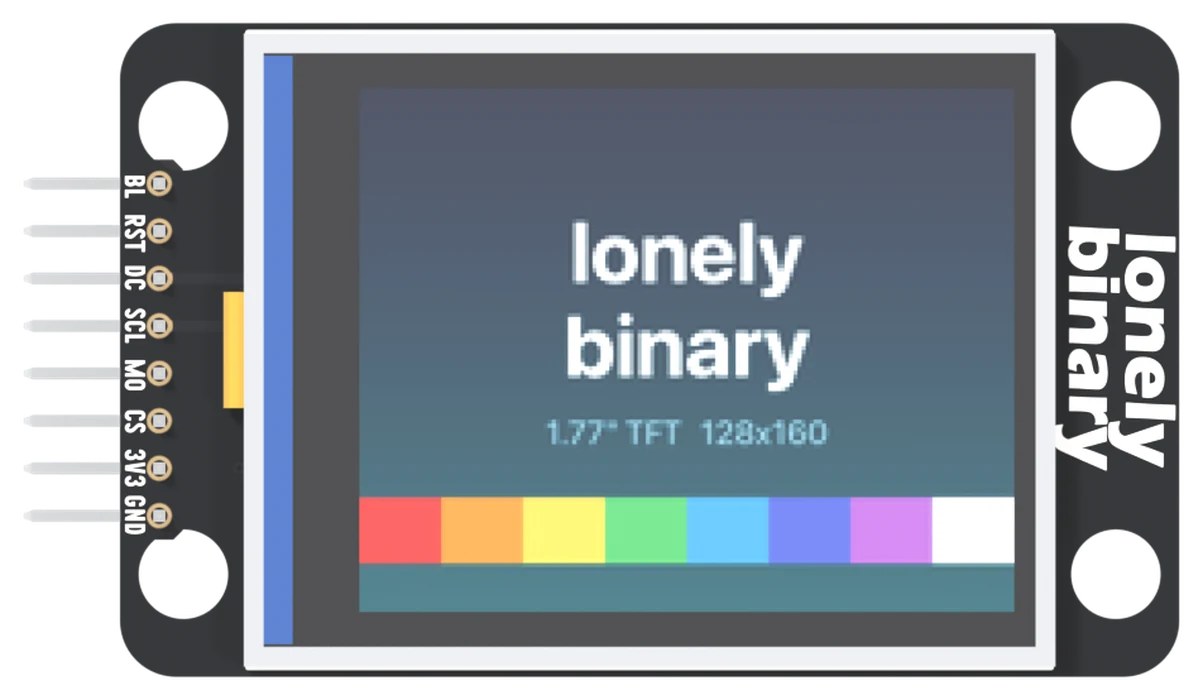
The screen side carries the panel and nothing else. Every part is on the back: the socket the panel's ribbon plugs into, the switch for the backlight, two capacitors and two pairs of solder pads.
U7 is a 12-way ribbon socket with a hinged latch, contacts 0.5 mm apart. Contact 1 is the backlight's return, 2 to 4 are 3V3, 5 and 11 are GND, 6 to 10 are RST, MOSI, SCL, DC and CS, and 12 is connected to nothing. Q2, R2 and R6 switch the backlight. C8, 10 µF, and C16, 100 nF, sit across 3V3 beside the socket. SB3 and SB2 are the BL-3V3 and CS-GND jumpers, both open.
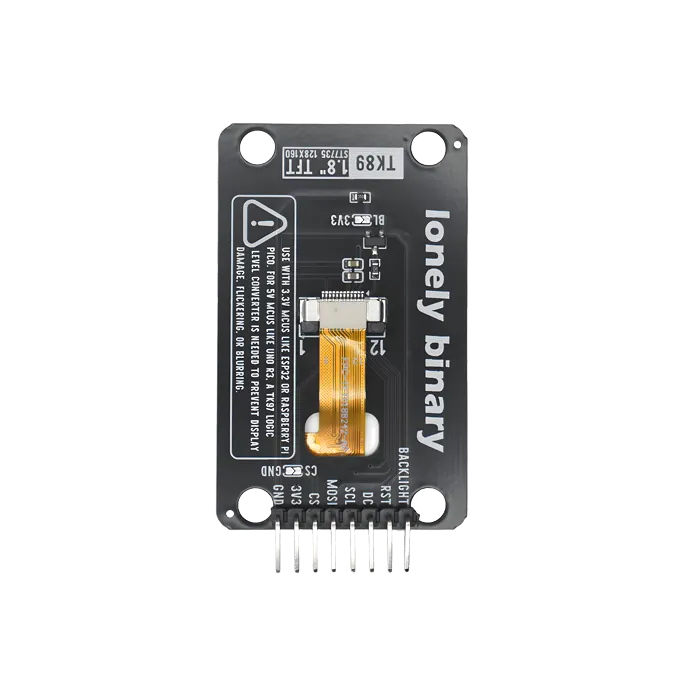
There is no regulator and no level shifter. What arrives on 3V3 reaches the glass, and so does every signal.
1.77 inches, sold as 1.8
The back prints 1.8" TFT and ST7735 128X160. The panel's drawing measures its picture at 35.04 by 28.03 mm, a diagonal of 44.9 mm: 1.77 inches. Displays are sold by that diagonal rounded to one decimal, so a 1.77-inch panel is sold as a 1.8. The controller is Sitronix's ST7735S.
On this board the panel lies on its side: 160 pixels across and 128 up, with the header to its left. The ribbon leaves the glass on that edge, where the blue strip is, folds behind the board and comes up through a slot to the socket. A pixel is 0.219 mm, about 116 to the inch.
When it does not work
Both. The picture's diagonal is 44.9 mm, which is 1.77 inches, and displays are sold by the diagonal rounded to one decimal. It is the same 128 by 160 glass either way.
Usually. Lift the socket's latch gently, slide the ribbon fully in with its contacts toward the socket's contacts, and press the latch down. Do it with the power off. A creased or torn ribbon cannot be repaired.
No. 3V3 goes straight to the panel and to the backlight's anode. There is no regulator and nothing to shift 5 V signals down, so the supply and every signal must be 3.3 V.
No. Some 1.8-inch display boards carry a microSD socket; this one has only the display, the backlight switch and the jumpers.
Why nothing on this board may see 5 V, and how an Uno gets round it.
Three volts only →Edit this page — content/books/tft-1-8-inch/what-is-on-it.mdx
Questions about this product
See what other owners have asked, and read their solutions.
1.8-inch TFT Display
Loading discussions…
Discuss this article
Ask about this page. The answer stays here, on the page it belongs to, for whoever hits the same wall next.