A narrow beam you cannot see
The LED stands up and shines straight away from the board, at 940 nm, in a beam 20° across: half as wide as the TK16's. The two blocks are the same circuit, part for part, and the same sketches drive both; the LED, and so the beam, is the whole difference.
Straight up, and narrow
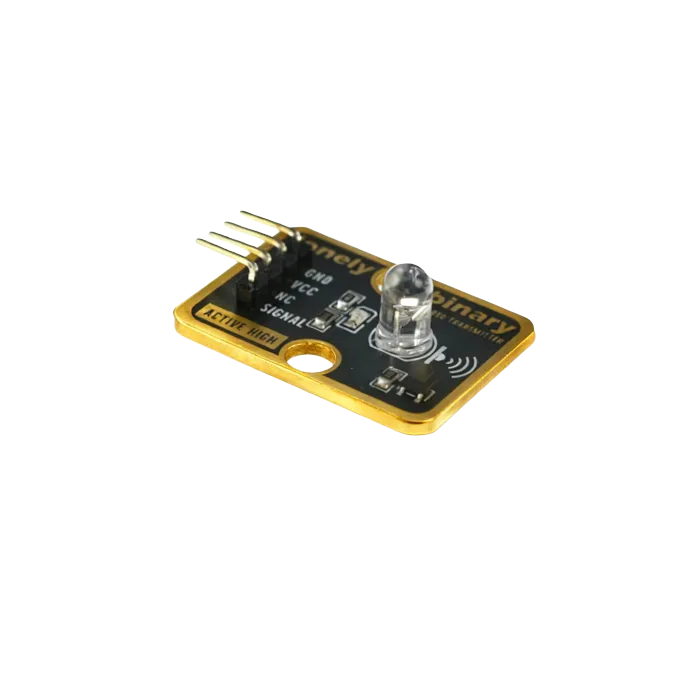
The infrared LED stands on its two legs, so its light goes straight up from the parts side of the board. To aim it at something, stand the block on its edge, or lay the other block face to face with it.
The data sheet gives its view angle as 20°: the light falls to half its straight-ahead intensity 10° either side of centre. That is a narrow beam.
Move the receiver off the centre line and watch the share of light it gets fall. The curve between the data sheet's two points is illustrative; the angles are not.
The TK16, beside it
The TK16 IR Sender is the same circuit, part for part: the same S8050, the same 150 Ω, 1 kΩ into the base, the red LED with its own 1 kΩ, and the same four pins. The only difference is the LED. The TK16 has a flat sidelooker lying on the board with a beam 40° across and a 50 mA rating; the TK63 has a 5 mm LED standing up with a beam 20° across and a 100 mA rating.
Half the angle holds about a quarter of the space, so for the same light the TK63's beam is brighter straight ahead and dimmer off to the side. The two data sheets do not rate brightness in the same units, so which LED gives more light in total is not something this book claims. In practice: the TK63 when you can aim, the TK16 when you cannot.
Anything the IR handbook does with a TK16, a TK63 does on the same pins with the same sketch.
940 nm
The LED's light peaks at 940 nm, 45 nm wide. That is past the red end of what an eye sees, and it is the wavelength remote-control receivers such as the TK15, and phototransistors such as the TK64's, are built to match. Many phone cameras can see a little of it, which the first blink uses.
When it does not work
Either. They have the same transistor, the same 150 Ω, the same pins and the same red LED, and IRremote drives both the same way. The TK63's narrower beam puts its light straight ahead and has to be aimed; the TK16's wider one is easier to hit a receiver with.
No. 940 nm is past the red end of what an eye responds to, and the LED looks the same lit or dark. Use the red LED on the board, or a camera.
It is a small LED run at a few tens of milliamps, the kind of part inside a television remote. There is still no reason to hold it against your eye: there is nothing to see.
Edit this page — content/books/ir-transmitter/a-narrow-beam-you-cannot-see.mdx
Questions about this product
See what other owners have asked, and read their solutions.
Infrared Transmitter
Loading discussions…
Discuss this article
Ask about this page. The answer stays here, on the page it belongs to, for whoever hits the same wall next.