What is on it
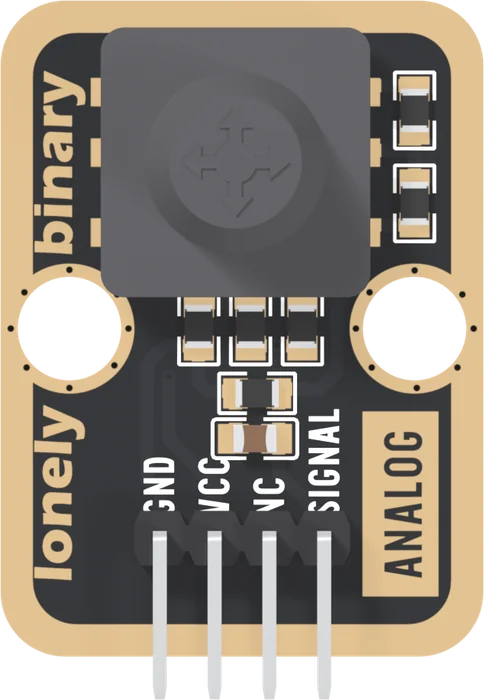
A XUNPU five-way switch under a black silicone cap, five 10 kΩ resistors in a chain from VCC to GND, a sixth from SIGNAL to GND, a 100 nF capacitor on SIGNAL, and a four-pin header. Nothing on the board needs power except the chain, which takes a fraction of a milliamp.
Nine parts
The parts list has nine lines, and every one of them is in the figure:
- U3, the switch: XUNPU's WS-1001-ACW09026, a 10 × 10.5 mm five-way navigation switch. Four tilts and a push, each closing a contact from one common pin. The black silicone cap on it is only a thumb grip.
- R7, R9, R10, R11, R12, the ladder: five 10 kΩ resistors, 1 %, in a chain from VCC to GND. Two stand to the right of the cap, three in a row under it.
- R14, 10 kΩ from SIGNAL to GND: it holds SIGNAL at 0 V with nothing pressed.
- C3, 100 nF from SIGNAL to GND, the brown part above the header. It steadies the reading, and it is why a reading takes a few milliseconds to fall after you let go.
- U10, a right-angle four-pin header, and the two LEGO-compatible mounting holes.
No chip, no LED, and nothing that needs setting up. The block is a switch and some resistors; your board's ADC does the rest.
The switch
XUNPU's drawing numbers the switch's six legs round its body and gives the circuit: one leg is common, and each of the five pushes joins it to one of the other five. On this board the common leg is SIGNAL, right's leg is VCC, and the other four go to the four joins in the chain. The drawing also gives 250 ± 50 gf to operate, 0.2 mm of travel and 50,000 cycles.
The back
When it does not work
The switch works without it: the cap only gives a thumb something to hold. It pushes onto the switch's square stem, 8.5 mm over the board. Press it back on straight, without twisting the stem; the switch's own travel is only about 0.2 mm.
The chain of five resistors always takes VCC across 50 kΩ: 66 µA at 3.3 V, 0.1 mA at 5 V. A push adds a little more; right, the most, adds VCC across 10 kΩ, so 0.4 mA in all at 3.3 V.
XUNPU's drawing gives 250 ± 50 gf to operate, 50,000 cycles, and 50 mA at 12 V DC through a contact at most. This board puts well under a milliamp through it, so the contacts are far inside their rating; the stem, not the current, is what wears.
Edit this page — content/books/five-direction-joystick/what-is-on-it.mdx
Questions about this product
See what other owners have asked, and read their solutions.
Five-Direction Joystick
Loading discussions…
Discuss this article
Ask about this page. The answer stays here, on the page it belongs to, for whoever hits the same wall next.