Under the digit
Take the digit away and there are ten parts under it: the 74HC595, one 150 Ω resistor for each segment and a 100 nF capacitor. Three of the chip's pins are set in copper, and one of them is why the board does not chain.
Ten parts you cannot see
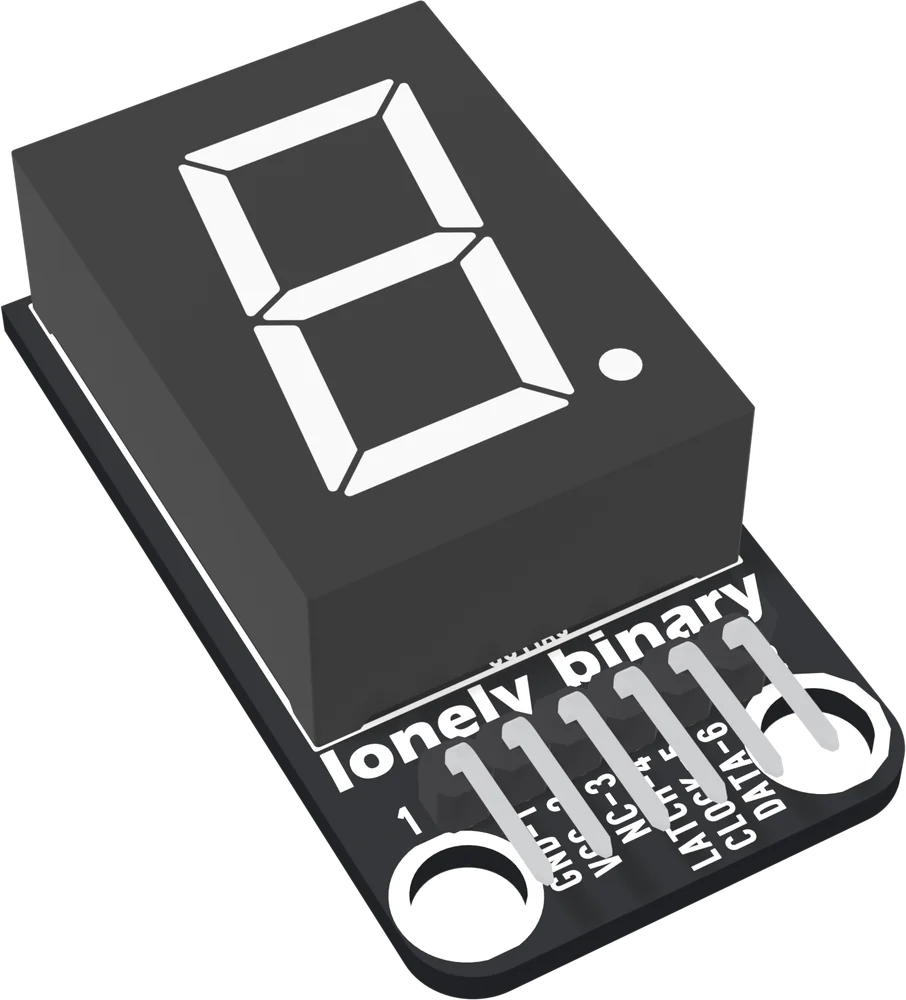
From the front the TK53 is a digit and a header. Everything else sits under the digit, in the gap between its body and the board.
The digit is ARKLED's SM420806N: 0.8 inch, red, ten legs. Eight are the seven segments and the dot, and two are the common, which is the cathode of all eight LEDs. Both common legs go to GND. So a segment lights when its own leg is driven up, and a 1 in the byte lights a segment. The 0.56-inch digits in the seven-segment kit come in both kinds; this board has only this one.
The 74HC595 is Nexperia's, in a 16-pin package. Five of its pins reach the header: VCC, GND, and the three that take your board's signals. Its eight outputs, Q0 to Q7, each drive one segment.
R1 to R8 are 150 Ω, one between each output and its segment. Each sets its own segment's current, so a 1 is as bright per segment as an 8.
C2 is 100 nF across the chip's supply, to hold VCC steady at the chip when several segments switch on at once.
Three pins set in copper
| Pin | Tied to | What it means |
|---|---|---|
| OE (13) | GND | the outputs are always on; no dimming through OE |
| MR (10) | VCC | nothing clears the register but a byte of zeros |
| Q7S (9) | nothing | no serial output leaves the board |
The last line matters most. On most 595 boards the ninth pin, Q7S (QH' on TI's datasheet), comes out to a header so a second board can take its data from the first. Here it goes nowhere. One latch per digit is what to do instead.
When it does not work
Not on this board. OE, the 595's output enable, is tied to GND in copper, so the outputs are always on. To dim it, show the digit for part of the time and a blank byte for the rest, fast enough that the eye averages the two.
Common cathode. The digit is ARKLED's SM420806N, and both of its common legs are on GND. A 1 in the byte lights a segment. A table written for a common-anode digit shows the gaps instead of the digit.
One on the common would share its current among however many segments are lit, so a 1 would glow brighter than an 8. One per segment sets each segment's current on its own, and every digit looks equally bright.
Eight bits down one wire, and the pulse that shows them all at once.
Shift, then latch →Edit this page — content/books/hc595-segment-led/under-the-digit.mdx
Questions about this product
See what other owners have asked, and read their solutions.
74HC595 Segment LED
Loading discussions…
Discuss this article
Ask about this page. The answer stays here, on the page it belongs to, for whoever hits the same wall next.