The four pins
Four pins, three of them wired. GND and VCC power a divider, SIGNAL is the voltage in its middle, and NC is connected to nothing. SIGNAL is an analog voltage, not HIGH or LOW, so it goes to an analog pin.
What is on the board
Three small parts and a four-pin header. At the top, inside a printed box with a thermometer beside it, is the thermistor: a resistor whose resistance changes with temperature. Below it are a 100 nF capacitor, the pale one, and a fixed 10 kΩ resistor, the dark one. The header is right-angled, so the pins point out past the bottom edge and the board lies flat.
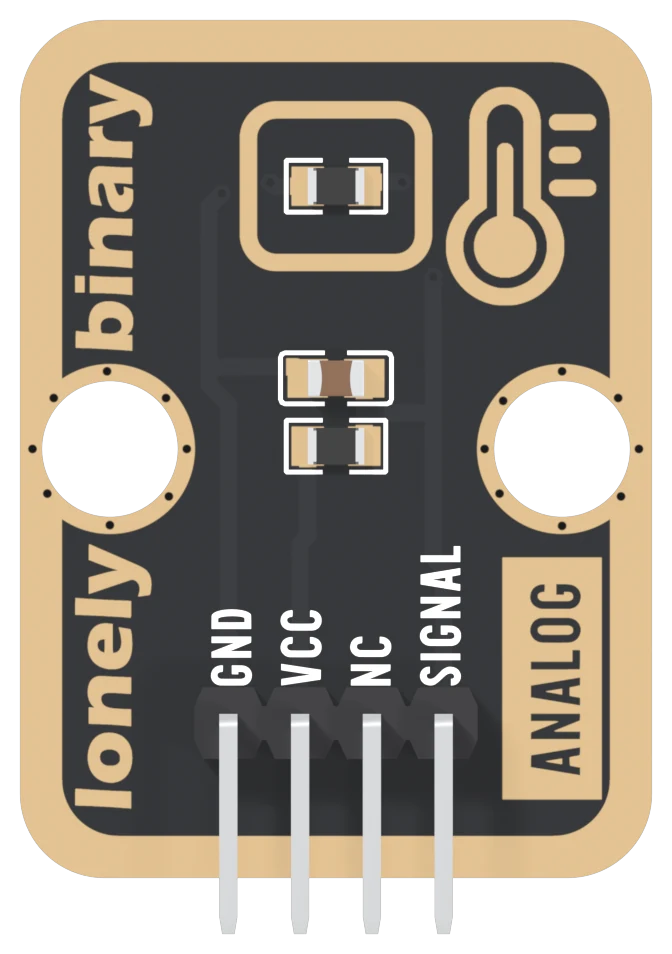
All three parts are 0805 size, 2.0 × 1.2 mm. The thermistor is that small on purpose: there is very little of it to warm up, so it follows a change quickly.
The four names
GND is on the square pad. The bottom of the thermistor and the capacitor both return here.
VCC goes to the top of the 10 kΩ resistor and nowhere else. It is the voltage the block splits, so SIGNAL is always some fraction of it.
NC means not connected, and on this board it means it literally. The net list, which is the list of every electrical connection on the board, does not mention it at all.
SIGNAL is the point between the fixed resistor and the thermistor. It is a voltage somewhere between 0 and VCC, and it goes to an analog pin. The front of the board says ANALOG for that reason.
The back of the board
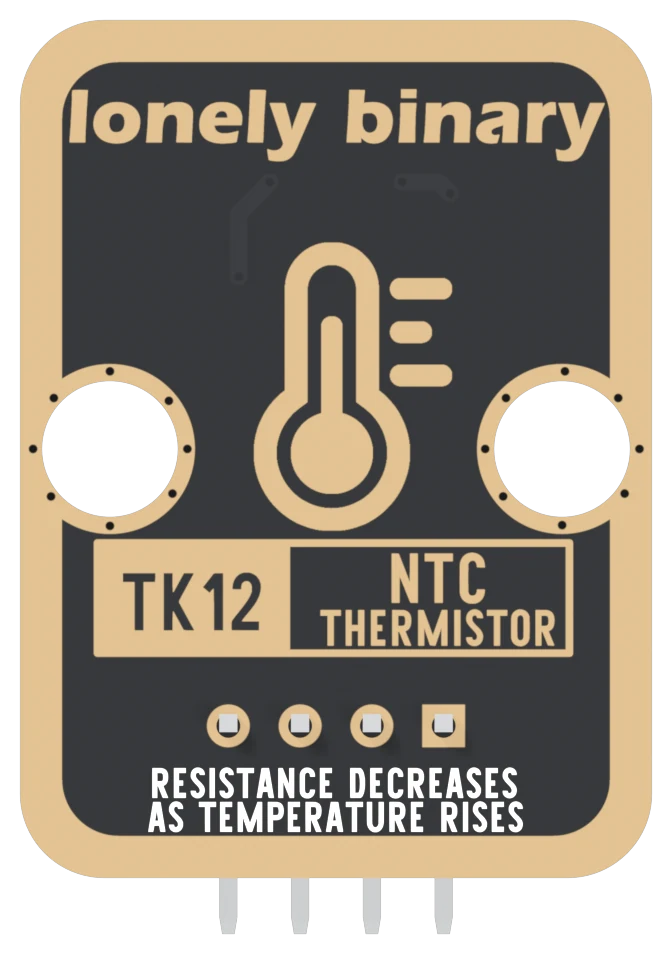
Turned over, the order reverses. The square pad is on the right, and it is still GND. The back prints TK12, the number on the box, and one sentence that is the whole of the next article: RESISTANCE DECREASES AS TEMPERATURE RISES.
When it does not work
Hold the board with the parts facing you and the header pins pointing down. Read GND, VCC, NC, SIGNAL from left to right. GND is also the square pad, which is the one mark that survives when the board is in a breadboard and the labels are hidden.
No. It is not connected to anything on the board, on either side. It is there so every TinkerBlock block has the same four-pin header and one cable fits all of them. Wiring it does no harm and changes nothing.
It can, but digitalRead only tells you whether the voltage is above or below a threshold, which here means roughly warmer or colder than 25 °C and nothing finer. For a temperature, use an analog pin: A0 on an Uno, GPIO 34 on an ESP32, GPIO 4 on an ESP32-S3, GP26 on a Pico.
Turned over, the order reverses: SIGNAL is on the left and GND on the right, and GND is still the square pad. The back prints the part number and RESISTANCE DECREASES AS TEMPERATURE RISES instead of the names. Count from the square pad.
The part in the box at the top, and what its part number says about it.
A resistance that falls as it warms →Edit this page — content/books/ntc-thermistor/the-four-pins.mdx
Questions about this product
See what other owners have asked, and read their solutions.
NTC Thermistor
Loading discussions…
Discuss this article
Ask about this page. The answer stays here, on the page it belongs to, for whoever hits the same wall next.